
Particularly hazardous substances of organophosphorus (OP) nature are very dangerous for human health and the environment. Many pesticide active constituents used in agriculture (paraoxon, methyl parathion, glyphosate, chlorophos), as well as chemical weapons and active pharmaceutical ingredients, are known or possible carcinogens, produce acute or chronic toxic effects, suppress immunity, cause disorders of the endocrine, central and peripheral nervous systems [1]. There is also evidence that OP have a negative effect on reproductive function, are teratogens, and pose an increased risk to children [2]. That is why one of the priorities of the chemical industry of Ukraine and the EU in general is the search for systems of OP decontamination and elimination of consequences of their action.
An effective method of OP destruction is alkaline hydrolysis in the presence of peroxide anion ($HOO^{-}$) [3]. Hydrogen peroxide ($H_{2}O_{2}$) was selected as the donor of these anions.
In this work, a decontamination composition with special rheological properties is developed, which makes it easy to apply to the skin and reduces the irritating effect of alkali. It is a highly alkaline solution (pH 13.0) of sodium hydroxide (NaOH) and $H_{2}O_{2}$. A pharmaceutically acceptable polymer (POL) was used to provide rheological properties.
Kinetic studies of the rate of decay of paraoxon by spectrophotometric method were also performed. Several systems were investigated: aqueous NaOH solutions with different hydrogen indexes (12.7 - 13.0) to determine the optimum pH at which the reaction rate is the highest; NaOH solution (pH 13.0) with POL; a solution of NaOH (pH 13.0) with $H_{2}O_{2}$; NaOH solution (pH 13.0) with $H_{2}O_{2}$ and POL (Fig. 1).
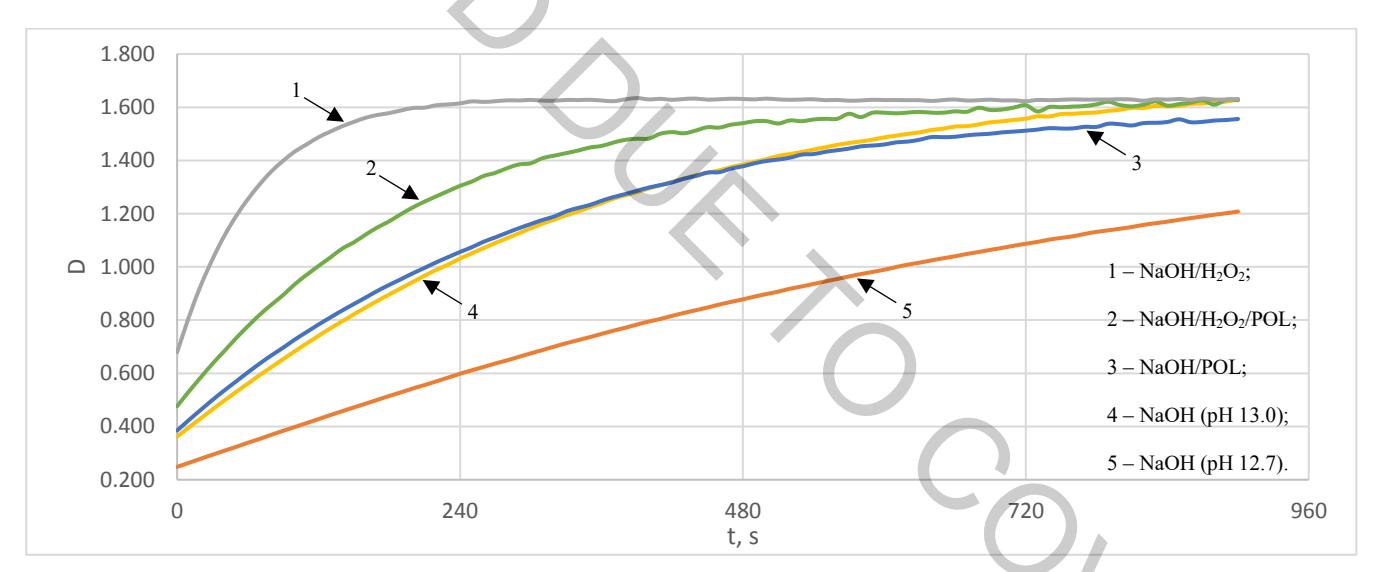
As a conclusion, the reaction rate is directly proportional to the pH, so the most alkaline solution (pH 13.0) should be used (curves 4, 5). In a system with aqueous NaOH solution, POL does not affect the decontamination rate (curves 3, 4). Addition $H_{2}O_{2}$ to the system increases the reaction rate (curve 1). The POL system exhibits greater stability over time, but a lower reaction rate during the first decontamination time (curve 2). In our composition, POL exhibits stabilizing properties, which has been demonstrated by reproducibility of results over several weeks.