
Optical fibers sometimes have to be exploited in environment affected by strong ionizing radiation. Therefore, radiation tolerance is an important parameter for such fibers. On the other hand, sensitivity to irradiation might be exploited for monitoring of the radiation. In this work, we analyzed the influence of the irradiation on the properties of optical fibers of various types by studying the radiation influence on the spatial distribution of photoluminescence (PL).
The experiment was performed using confocal microscope Witec Alpha 300s. All of the samples were excited with Alphalas laser emitting at 405 nm. PL signals were analyzed by a spectrometer and registered by a thermoelectrically coolled CCD camera. The spatial PL parameters were analyzed in commercially produced fibers of 6 different types: DRAKA SMF, DRAKA MMF, Nufern, Nufern RI310 HTA, Ver-MMF-50-4-P-12, and VIP-125-3. For all 6 types, two samples have been prepared. One of them was irradiated, whereas the second one was virgin.
Typical results for fibers of two types, VIP-125-3 and DRAKA MMF, are presented in Figs. 1 and 2, respectively. Optical fiber VIP-125-3 consists of two layers: a core is surrounded by a coating layer. As evident in Fig. 1, the spectra of this fiber has significantly changed after being exposed to intense irradiation. The irradiation results in a blue shift of the main emission band of the fiber by 120 nm.
The optical fiber DRAKA MMF has three layers: the core in this fiber is surrounded by inner and outer coatings. As seen in Fig. 2b, the radiation has no impact on the peak position of PL in high intensity areas of fiber cross section. The PL band is peaked at ~475 nm.
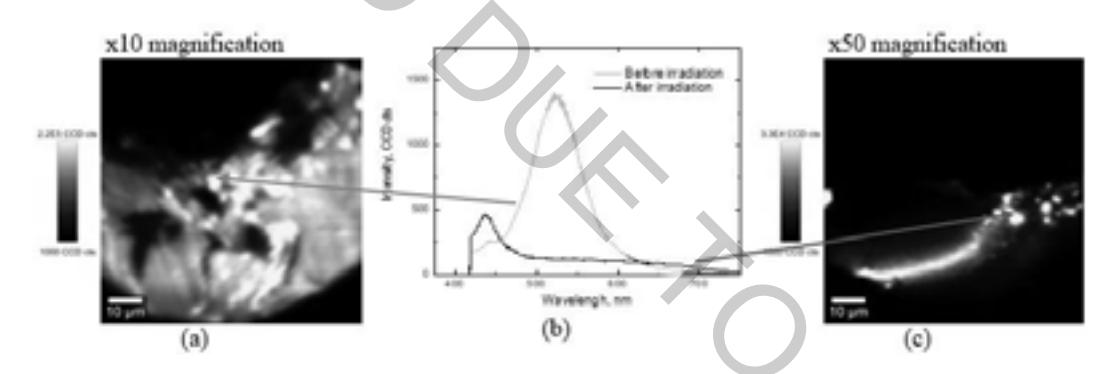
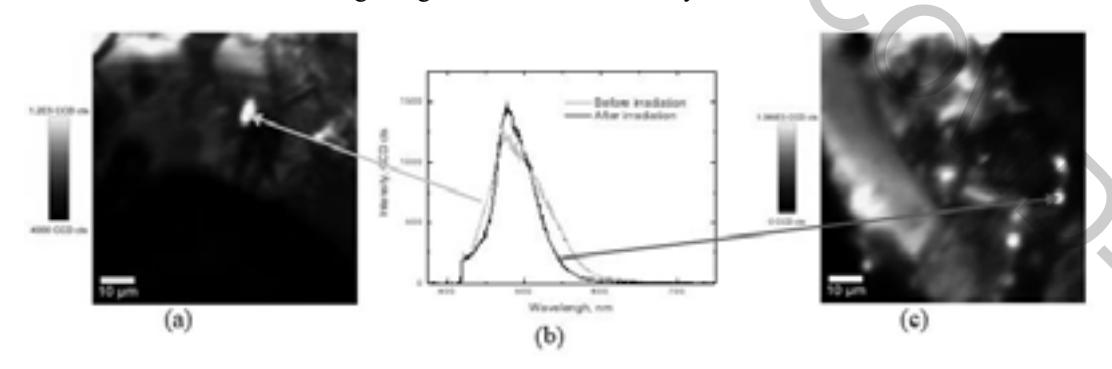
Our results show that DRAKA MMF fibers exhibit a high radiation tolerance and might be exploited in harsh irradiation environments. Meanwhile both intensity and band position of PL band in VIP-125-3 is sensitive to irradiation. Thus, this type of fiber might be used for measuring irradiation dose. Fibers of other four types are also analyzed from this point of view.