
The Baltic Sea is under high anthropogenic pressure due to the impact of the coastal territories of densely populated nine countries. It is generally accepted that the main sources of radionuclides in the Baltic Sea are global fallout after nuclear weapons tests, pollution after the Chernobyl accident and releases from European nuclear facilities. Although the radiological situation in the Baltic Sea is constantly monitored, there is a lack of data on actinide contamination, which is most likely associated with difficulties in determination. Besides, recent studies of the plutonium isotopic composition in bottom sediments have revealed unclear sources of pollution. Currently, monitoring the radiological situation is also of particular importance due to the operation and construction of new nuclear plants.
Most of the information about contamination of bottom sediments deals with 137Cs and 90Sr, while less attention is paid to Pu isotopes. The possible application of radionuclides to trace the spread of pollutants in the Baltic has been discussed in recent publications [1-3]. However, the current state of knowledge in this area is still insufficient to conduct tracer research. The most promising indicator for studying redistribution of sediments and assessing the pollution sources are Pu isotopes [4], due to their long half-life compared to 137Cs. 241Am can also serve as an indicator, but there is a significant lack of information about its activity concentrations and behavior in the Baltic Sea [2].
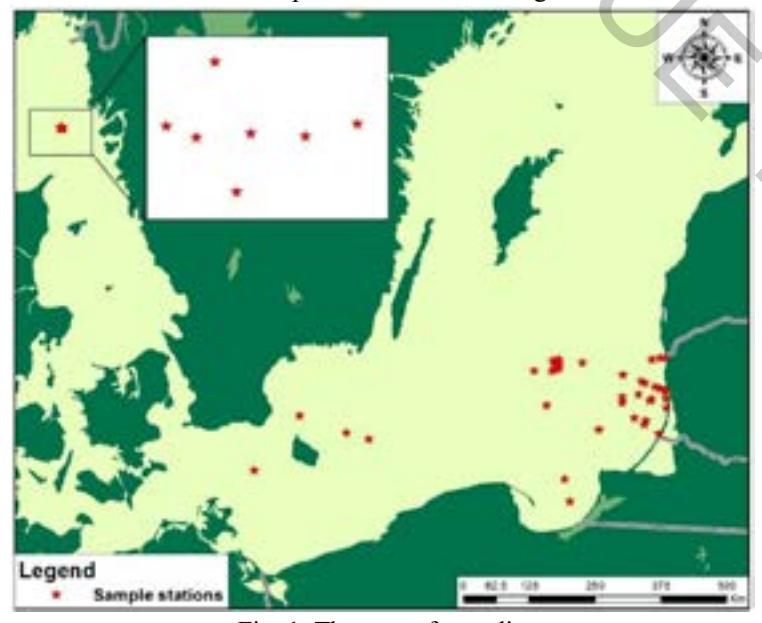
This study aims to assess the concentrations of 137Cs, 241Am and 239,240Pu 240Pu as well as radionuclide and 240Pu/239Pu atom ratio in the bottom sediments of the Baltic Sea with a view of applying these data in tracer studies. A sampling of bottom sediments was carried out by the Environmental Protection Agency (Klaipėda, Lithuania) and by P.P. Shirshov Institute of Oceanology RAS (Moscow, Russia). Bottom sediment samples of the surface layer of 0–5 cm were taken from a depth of 43–220 m using a Van Veen Grab Sampler. The location of the sampling station is shown in the figure (Fig. 1.).
137Cs activities were measured with HPGe detectors (resolution 1.8 keV (FWHM) at 1.33 MeV and efficiency 42%). Samples were ashed at 550°C and then dissolved in strong acids. The TOPO/cyclohexane extraction and radiochemical purification using UTEVA, TRU and TEVA resins (100-150 mm) were used for separation of Am and Pu isotopes. 242Pu and 243Am (AEA Technology UK, Isotrak, QSA Amersham international, PRP10020 and ATP10020) were used as yield tracers. Plutonium and Am after purification were electroplated onto stainless steel disks and measured using an alpha-spectrometry system with passivated implanted planar silicon (PIPS) detectors, 450 mm2 active area (AMETEK, Oak Ridge, Tenn, USA). The Pu isotope ratios after additional purification were determined by the AMS.
The preliminary results indicated that activity concentration of 137Cs, 241Am and 239,240Pu in studied samples ranged from 1.9 to 220 Bq/kg, from 0.02 to 0.13 Bq/kg and 0.02 to 3.03 Bq/kg, respectively. The obtained results will be used in tracer studies.