
Usually in photoluminescent materials absorption of light brings the luminescent impurity into an excited state, which typically has a lifetime of nanoseconds up to a few milliseconds, depending on the specific electronic transition and the host-dopant interactions [1]. A persistent phosphor is a specific modification of such a photoluminescent material, where energy is stored in the so-called traps. Red and near-infrared light can be used to empty those traps, in a process called optically stimulated luminescence (OSL). The amount of emitted light is proportional to the number of trapped charges [2]. Persistent phosphors, where ambient heat is driving the release of the trapped energy, have shown their potential to be used in various glow-in-the-dark applications, ranging from emergency signage and watch dials to toys, and in light dosimetry [3,4].
The main focus of this research was to synthesize SrAl2O4:Eu2+,Sm3+ phosphors with various concentrations of dopants using solid-state synthesis method and determine how the chemical composition of the synthesized materials affects their spectroscopic and energy storage properties (ability to accumulate energy within itself).
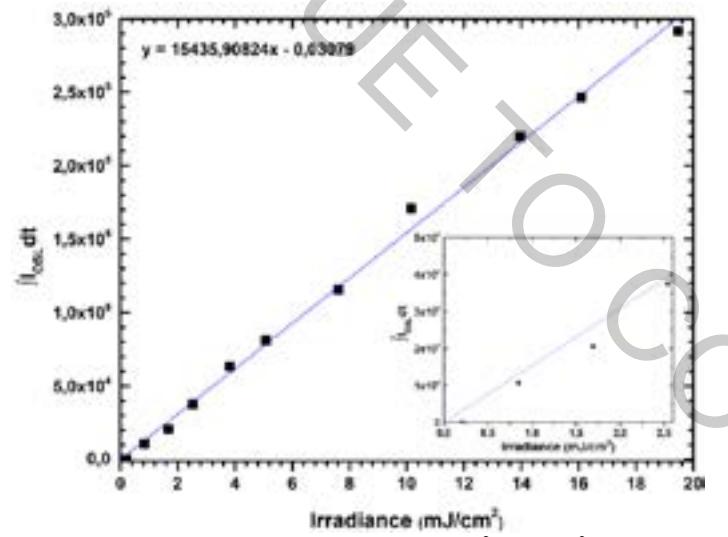
The obtained results show that after optimizing the amount of flux agent in solid-state synthesis, the method can be used to obtain phase pure samples. Furthermore, the afterglow of this green emitting phosphors (${\lambda}_{max} = 520$ nm) goes out very quickly compared to other persistent phosphors, e.g., Eu2+, Dy3+ doped SrAl2O4. This shows that the trapped charges are stable at room temperature. The energy accumulated in the sample can be released by irradiation with stimulation light and the intensity of the OSL was shown to depend linearly on the applied dose (Fig. 1), fulfilling a key requirement for dosimeters.
Powder X-ray diffraction, emission and excitation spectra, energy storage capacity and diffuse reflectance measurements have been recorded to characterize crystal structure and spectroscopic properties of the synthesized samples.