Optical modulators are devices used to modulate a beam of light. They are used in various laser applications – regenerative amplifiers, electro-optic and acousto-optic laser beam scanners, laser-induced damage testing, laser microfabrication and modification of materials [1-2]. The most commonly used optical modulators in high-power laser systems are electro-optic modulators. They are based on the Pockels effect: when an external electric field is applied to non-centrosymmetric crystals, their refractive index changes. Consequently, a polarization change in the beam traveling through the crystal of the Pockels cell is induced, which enables the Pockels cell to be used as a voltage-controlled phase plate [3]. Beta barium borate (BBO) crystals are a widely used material for Pockels cells due to their wide transmission range, relatively high optical damage threshold and thermal stability [4-5]. However, propagation of high average power laser radiation through a Pockels cell leads to heating of the electro-optic crystal due to absorption [6]. Induced thermal load in a Pockels cell leads to thermal effects which degrade its performance, such as wave-front aberrations, stress-induced depolarization, reduced contrast ratio and thermal fracture [7]. Therefore, it is important to investigate these phenomena and determine means to reduce them.
In this work self-heating effects were investigated in a special pulse picker "MP1" which was designed and made by Lithuanian company "Optolita" and used specifically designed BBO Pockels cell with water and thermoelectric cooling. Pulse picker "MP1" can output $100~\text{ns}-1~\text{ms}$ duration laser pulse trains with repetition rate of $10~\text{Hz}-250~\text{kHz}$, BBO crystal dimensions were $4 \times 4 \times 20~\text{mm}^3$, half-wave voltage was $4.5~\text{kV}$. A $15~\text{W}$ average power femtosecond laser system "Pharos", which was made by Lithuanian company "Light Conversion", generating $1026~\text{nm}$ wavelength, $609.4~\text{kHz}$ repetition rate and $260~\text{fs}$ pulses, was used as a laser source.
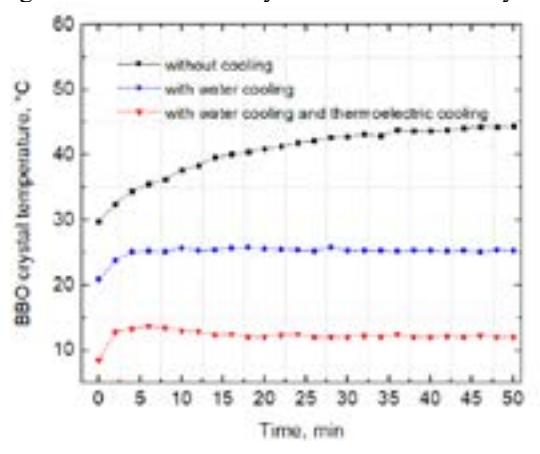
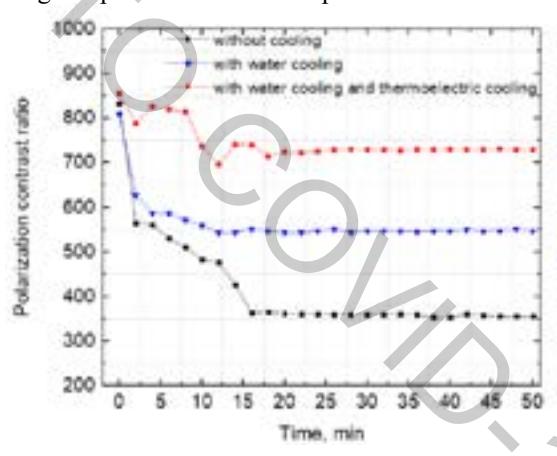
The dependence of the contrast ratio and crystal temperature of a BBO Pockels cell on the high-voltage control signal frequency was investigated in this study. Results show that the temperature of a BBO crystal increases with time and stabilizes after 36 minutes when no cooling was used (Fig. 1). A radial thermal gradient produces a radial strain as well as dilation of the crystal and due to stress-induced depolarization optical contrast ratio of a BBO Pockels cell decreases up to 2.13 times at the highest non-resonant high-voltage control signal frequency which in this case was 200 kHz. The results obtained show that by using water and thermoelectric cooling the temperature rise of the BBO Pockels cell crystal stabilizes much quicker (≈4 min.), the contrast ratio is 1.5 times higher with water cooling and 2 times higher with thermoelectric cooling (Fig. 2) than it was compared to case without active cooling. Thus, active cooling of the Pockels cell crystal is an efficient way to obtain the highest possible and stable optical contrast ratio.