Multifunctional molecular systems offer a wide range of unique properties promising in the development of future technologies. One of them is magnetic sensing technology operated by external stimuli such as applied light. In photomagnets two distinct switchable magnetic states can be obtained upon light irradiation due to the presence of the photomagnetically-active ions.
Magnetic and photomagnetic properties of three photoactive coordination polymers based on Cu2+ and $[Mo_{2}(CN)_{8}]^{4-}$ ions were investigated in this work: racemic 2-D system $[Cu(chxn)_{2}]_{2}[Mo(CN)_{8}]\cdot 3H_{2}O$, chiral 1-D chain $[Cu(RR-chxn)_{2}]_{2}[Mo(CN)_{8}]\cdot H_{2}O$, and chiral 1-D chain $[Cu(SS-chxn)_{2}]_{2}[Mo(CN)_{8}]\cdot 1.5H_{2}O$.
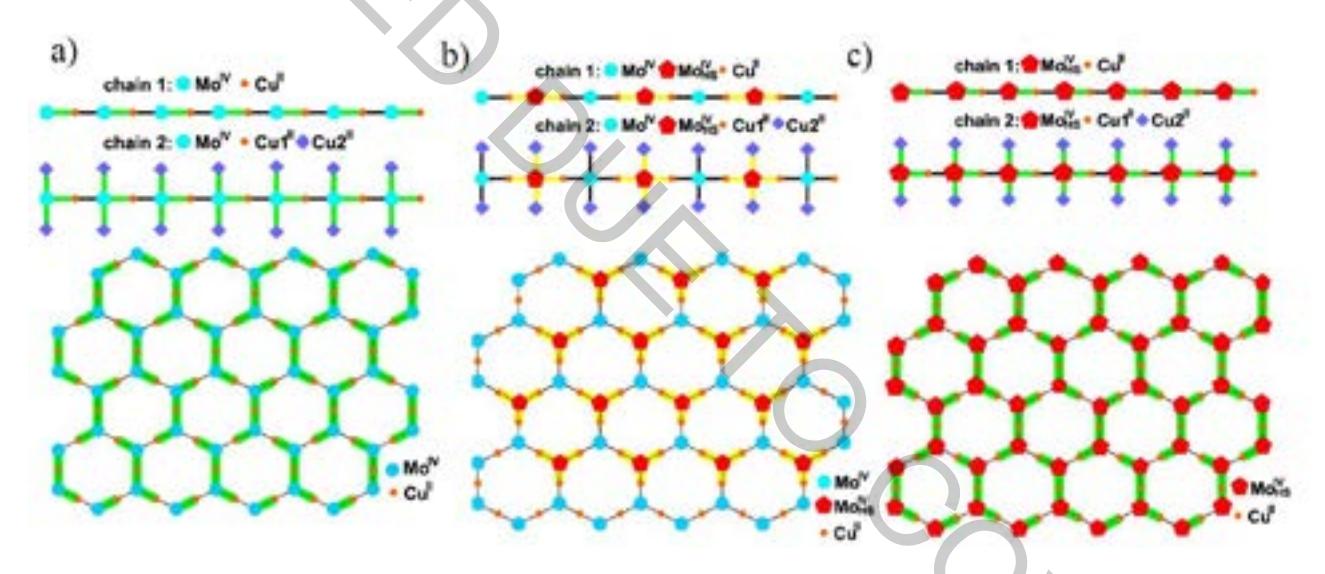
Analysis of the properties of the samples would require non-trivial and time-consuming Monte Carlo simulations. Instead, a simplified approach based on the molecular field approximation (MFA) was taken. As the efficiency of the irradiation process was not known (the molecular fraction of the MoIV that undergo the spin-crossover transition to the metastable state MoIVHS), two independent models were considered for the excited samples. The first one corresponds to the situation where a relatively small fraction of MoIV becomes excited (formation of isolated $[Cu^{II}]_{3}Mo^{IV}_{HS}$ units), and the second assumes a 100% efficiency of light irradiation (Fig. 1).