NaYF4 materials doped by rare-earth ions has caught scientist attention because of fluoride unique properties, such as low phonon energies, tunable crystal phase, high refractive index and chemical stability. Upconversion nano- and micro- particles doped by rare earth elements are able to convert low-energy near-infrared (NIR) photons into higher-energy visible or ultraviolet photons, this mechanism provide high excitation penetration depth in tissues and, additionally, absence of autofluorescence. Because of these characteristics, NaYF4 doped by rare earth elements can be utilized in diagnostics and biomedical imaging systems. Rare earth doped NaYF4 can also be applied in light emitting diode (LEDs) displays, solar cells, lasers and optoelectronic devices.
$\beta$-phase NaYF4 nanocrystals or microcrystals have been considered as better upconversion host material compared with $\alpha$-phase. This is the reason why the main focus was on obtaining $\beta$-phase particles. The samples were prepared via hydrothermal method, which is suitable and effective solution-based technique that can used to prepare stabile crystalline phases at considerably low temperatures. We experimentally verified the role of chelating agent, pH value and hydrothermal reaction time in the synthesis of $\beta$-NaYF4.
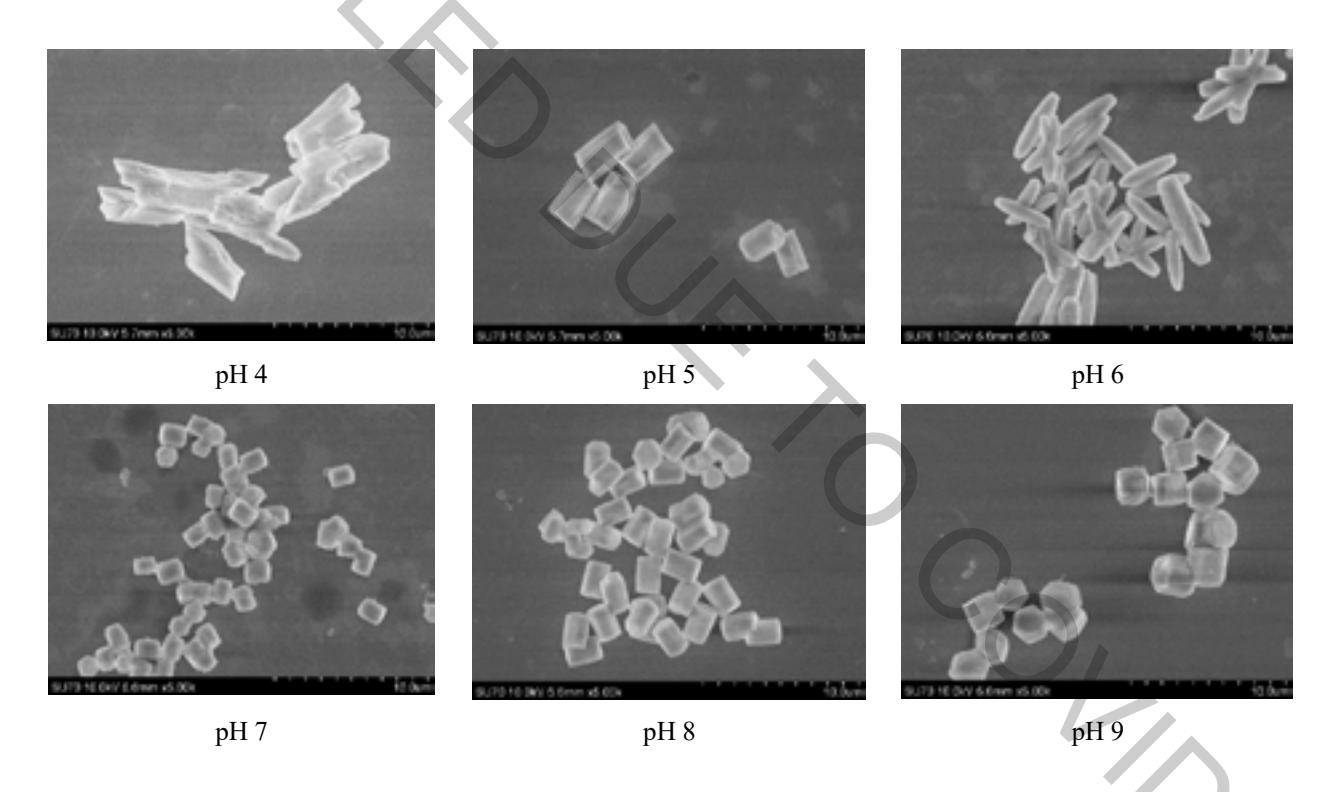
Synthesized samples were characterized by X-ray diffraction (XRD) and scanning electron microscope (SEM) (figure 1).