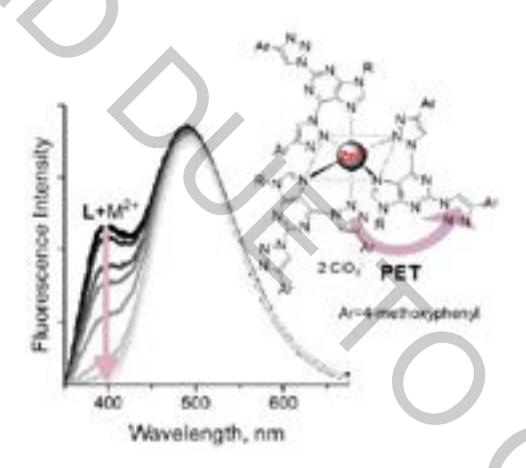
The control of photophysical properties of purine-based compounds is of a great importance. The wide possibilities of purine core modification by addition of electron accepting or donating substituents allow creating push-pull molecular systems with desired features. Here we present four 9-(3',5'-di-O-acetyl-2'-deoxy-$ \beta $-D-ribofuranosyl)-2,6-bis-(1H-1,2,3-triazol-1-yl)-9H-purine derivatives which in case of electron donating substituents become unique Donor-Acceptor-Donor' systems with unusual character of dual emission. The steady-state absorption, fluorescence and excitation, time-resolved fluorescence experiments and DFT calculations were employed to study the nature of dual fluorescence, which was attributed to distinct transitions within electron donating branches. The NMR study of 9-(3',5'-Di-O-acetyl-2'-deoxy-$ \beta $-d-ribofuranosyl)-2,6-bis-[4-(4-methoxyphenyl)-1H-1,2,3-triazol-1-yl]-9H-purine with metal ions proved the efficient assembly of three purine molecules to one metal ions. As revealed by steady-state fluorescence titration experiments, the complexation causes the quenching of blue side band of dual fluorescence, determined by an efficient interbranch intermolecular photoinduced electron transfer (PET), which was further analyzed by transient absorption experiments. The unique dual fluorescence along with an efficient PET as metal ion sensing mechanism enables to propose a new concept of a ratiometric chemical sensor.