
Complex organic molecules including an adamantyl fragment in their structure are used as the basis for antiviral and antibacterial agents. They also possess antimicrobial, anti-inflammatory and anti-proliferative activities [1]. Such molecules usually have a complex spatial structure, may have a number of equilibrium configurations, which complicates the prediction and interpretation of the spectral characteristics of such molecular systems.
In this study the structural, spectral, and energy characteristics of (Z)-3-(adamantan-1-yl)-1-(3-chlorophenyl)-S-benzylisothiourea are presented. The calculations of structural characteristics were performed within the framework of the Density Functional Theory (DFT) by using B3LYP functional and cc-pVTZ basis set. These calculations showed the existence of four stable conformers arising from the rotations around S–C and N–C single bonds with 0 (Fig. 1a), 103, 289, and 1341 cm-1 relative energies. The results of the current calculations are confirmed by X-ray analysis performed for the crystalline phase earlier [2].
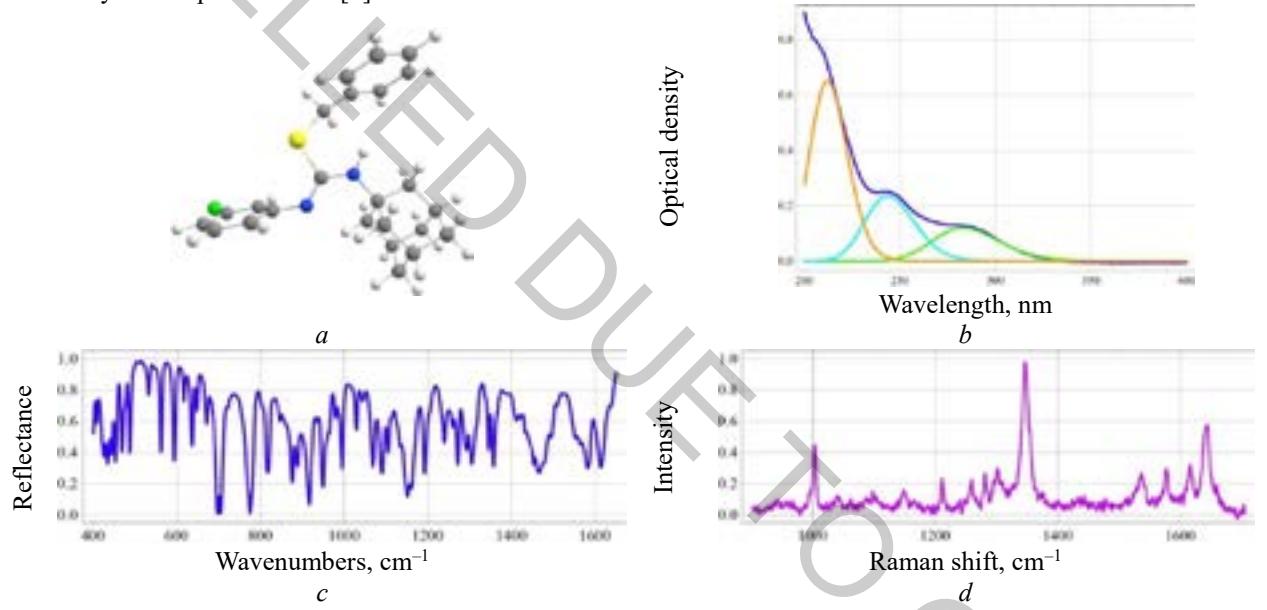
The FT-IR (reflection mode, Fig. 1c) and Raman scattering (Fig. 1d) spectra of the compound for the crystalline phase were measured in the ranges of 4000–400 and 3200–150 cm-1, respectively. The vibrational IR and Raman spectra were also predicted for all conformers at the B3LYP/cc-pVTZ level of theory in the harmonic approximation. According to the results obtained, the assignment of the frequencies of the calculated spectra differs for each of the conformers and the difference is most noticeable in the low-frequency region. The experimental spectra were completely interpreted by using the results of our calculations.
The UV/Vis spectrum of the solution of the compound in ethanol (Fig. 1b) was measured in the range of 400-200 nm. The spectrum of electronic absorption turns out to be complicated with three maxima observed. For interpreting the experimental spectrum the calculations for all conformers at the Time-Dependent DFT (TDDFT) and Multi-Reference Perturbation Theory (MRPT) levels of theory were performed. The results of the MRPT calculations with taking into account Boltzman distribution for the conformers qualitatively and quantitatively fully reproduce the experimental spectrum. The results of the calculations performed within the framework of TDDFT completely diverge with the experimental data, which shows the inapplicability of this approximation for the molecular system under study. It is highly probable that this is a consequence of the intramolecular charge transfer.