
Currently due to many applications in imaging and spectroscopy, terahertz (THz) radiation is a subject of great interest. One of the most efficient methods of creating very strong electric fields of THz radiation is using bichromatic femtosecond laser pulses consisting of the first and second harmonics (FH and SH, respectively) to create a plasma filament where THz pulses are emitted[1, 2]. In this research we conducted experiments studying properties of THz signal (modulation of intensity and azimuthal phase), emitted from laser induced plasma in air, when one or both of the pump beams were carrying an optical vortex charge. For the experiments we have used a Ti:sapphire laser system (Legend elite duo HE+, Coherent Inc.), delivering pulses with duration of 40fs (FWHM), central wavelenght of 800nm and a repetition rate of 1 kHz.
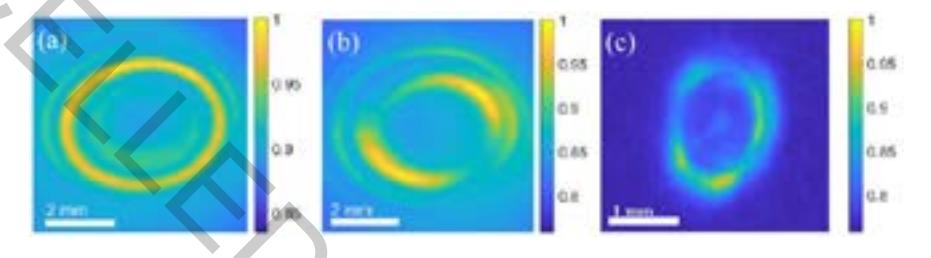
In our experiment we used two different methods for optical vortex generation. For generation of optical vortex with a topological charge of $\pm 1$ we used an s-waveplate and for generation of topological charge $\pm 2$ a nonlinear crystal was used. We used a thermographic camera to observe THz signal spatial distribution while using different combinations of topological charges of the excitation beams. It was found that when an optical vortex in a pump beam is being used, THz beam also aquires a phase modulation of a vortex. which was found by examining its intensity distributions in a collimated beam as well as focal plane of the cilindrical mirror. Moreover it was found that THz beam profile aquires different intensity modulation depending on a resulting topological charge of a THz vortex beam.
Therefore we investigated THz signal when there is an azimuthal phase modulation in one or both of pump beams. We believe that the presented investigations will open new routes towards an active control of ultra-broadband THz beam properties.