Electrochemical batteries are deemed to be one of the most attractive alternatives for electrical energy storage, covering the widest available power and energy range as well as having superior round-trip energy efficiencies, low environmental footprint, and easy scalability. Li-ion batteries are more and more widely used as rechargeable power sources, owning to their high energy and power density. However, the high cost of Li and necessary transition metals as well as safety issues related to the use of highly flammable electrolytes have pushed towards the search for alternatives. Na-ion batteries and especially their aqueous variants are attracting particular attention as potential candidates for large-scale energy storage because of the accessible and unlimited Na resources and elimination of certain rare transition metals. Moreover, the aqueous aspect makes them significantly safer, non-flammable, low cost and environmentally friendly in comparison to the current Li-ion technology [1-3]. NASICON (Na SuperIonic Conductor) type compounds have been intensively investigated as promising cathodes and anodes for Na-ion batteries due to their open framework structure which enables fast Na ionic conduction and provides superior electrochemical durability [4].
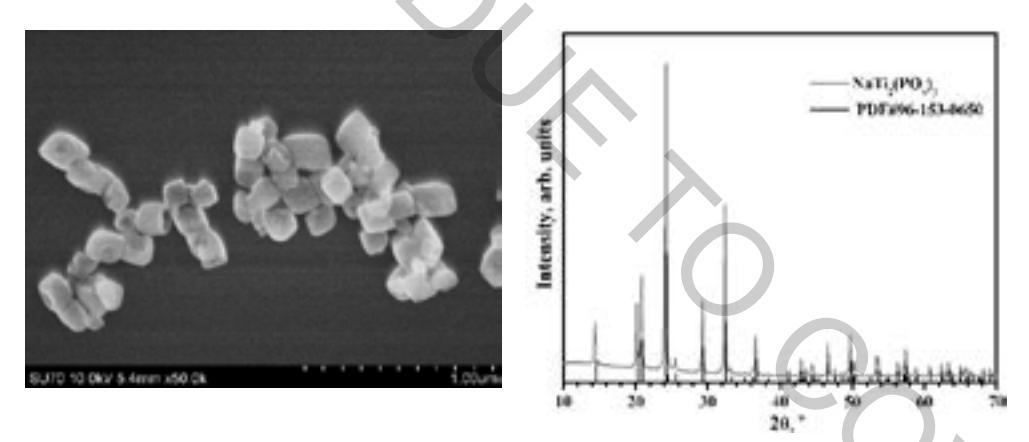
The aim of this work is to find new materials based on such phosphate frameworks suitable for application as novel battery electrode materials, optimize their properties, morphology and composite microstructure for the use in aqueous Na-ion battery cells [5]. Pure phase NASICON-type NaTi2(PO4)3 material is synthesized by hydro(solvo)thermal synthesis method by varying a number of parameters such as solvent (ethylene glycol, ethanol, water), temperature (140-200°C) and synthesis time. The structure and morphology of prepared materials are characterized by X-Ray Diffraction and Scanning Electron Microscopy. The electrochemical properties of prepared NaTi2(PO4)3 based electrodes are investigated by Cyclic voltammetry and Charge/Discharge galvanostatic cycling in the three-electrode bottom mount flat sample beaker cells. The results (Fig. 1) show that truly nanostructured pure phase NaTi2(PO4)3 and carbon composites could be obtained using the hydro(solvo)thermal methods showing superior electrochemical response.