Second harmonic generation is widely used technique to obtain visible light source in laser physics. There are many parameters which affect second harmonic generation (SHG) efficiency and laser beam quality, as pulse energy, beam size, pulse duration, the non-linear properties of the crystal, crystal length, group velocity mismatch between the fundamental and generated second harmonic (SH) pulses and the group delay dispersion (GDD) [1,2].
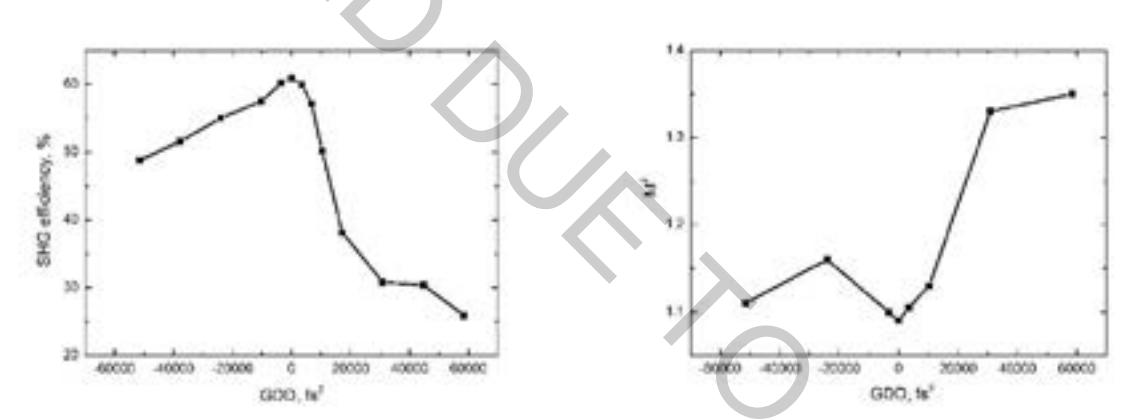
In this study we present our investigation of GDD influence to SHG efficiency and spatial beam quality parameter M2 of SH. In the experimental system, second harmonic pulses were produced in lithium triborate (LBO) crystal using femtosecond (<300 fs) fiber laser (FemtoLux3, Ekspla). GDD and pulse duration was controlled with linear temperature gradient along the chirped fiber Bragg grating which was used as pulse stretcher. The measured SHG efficiency and SH beam quality parameter M2 dependence on GDD is shown in Fig. 1. The best SHG efficiency of 61% was achieved at GDD value of zero. The efficiency of the second harmonic drops down with the variation of the positive and negative GDD. Measured beam quality parameter M2~1.09 of the SH was close to the diffraction limit indicating excellent beam spatial properties. We observed that this dependence is asymmetric for positive and negative GDD values. SHG efficiency and SH beam quality drops sharply for positive GDD, while for negative GDD these parameters decrease more slowly. It was shown by numerical simulations that this asymmetric behavior was caused by uncompensated fourth order dispersion in the laser system or self-phase modulation in the fiber amplifier [2]. Detailed information about numerical calculations and experimental results will be presented at the conference.