
According to the World Health Organization, about 3 million pesticide poisonings occur worldwide each year. The use of organophosphorus substances is poorly regulated and their easy accessibility is a consequence of a large number of self-poisonings [1]. The main pathogenetic mechanism of action of organophosphorus compounds is based on the inhibition of the activity of cholinesterases - enzymes that hydrolyze acetylcholine and butyrylcholine and play an important role in the process of synaptic transmission of nerve impulse in cholinergic entities [2]. Therefore, the development of new ways of preventing poisoning with organophosphorus toxic substances is relevant.
As a model substance used paraoxone. The aim of the study was to determine the activity of human serum butyrylcholinesterase in the presence of paraoxon and with the preliminary inhibition of the enzyme by the model flavonoid hesperidin.
The study is based on the determination of ex vivo human serum butyrylcholinesterase activity using a modified Ellman method. This method is based on the ability of the thiocholine, the reaction product, to restore potassium hexacyanoferrate (III), which is colored yellow, to potassium hexacyanoferrate (II), which is practically unpainted. This allows direct photometric registration of the rate of enzymatic reaction.
According to the results of the study, diagrams of changes in the activity of human serum butyrylcholinesterase in the presence of paraoxon (0.01 mkM) and with the preliminary addition of hesperidin (50; 100; 200 mkM) were constructed (Fig. 1).
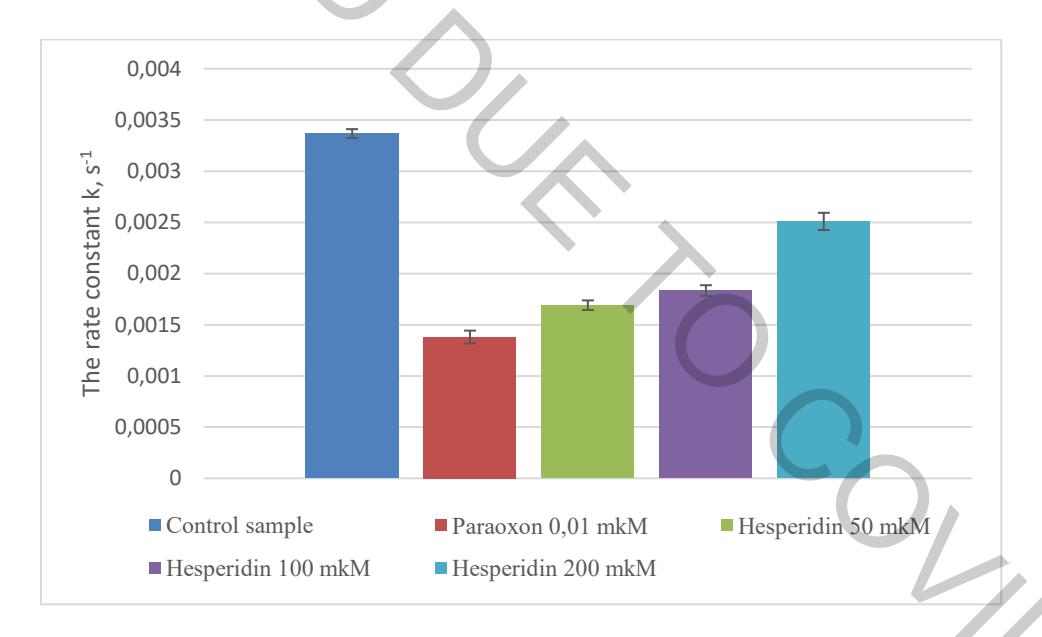
With the addition of paraoxone, the activity of butyrylcholinesterase decreased dramatically. But in the next experiment, when previously added to the system of hesperidin, the degree of inhibition of butyrylcholinesterase by paraoxone is reduced by almost 45%. It is shown that the higher the concentration of hesperidin, – the higher the activity of butyrylcholinesterase. Hesperidin is a reversible inhibitor. Prior to the addition of hesperidin to the serum, it binds to the active center of butyrylcholinesterase, leaving no room for paraoxon. Over time, hesperidine exits the active center and the enzyme activity is restored.
The established effect can be used in the development of new drugs for the prevention of poisoning by organophosphorus toxic substances.