From the standpoint of fabrication technology, doping-free organic light-emitting diodes (OLEDs) are more appealing than the doped ones [1]. Recently, 21% external quantum efficiency was archived for non-doped solution-processed sky-blue thermally activated delayed fluorescence OLEDs using multi-donor/acceptor emitter with through-space/-bond charge transfer [2].
To further understand impact of acceptor substitution patterns of multi-donor/acceptor emitters, five multi-carbazole derivatives were substituted by different acceptors in this study. Non-doped films of those derivatives were characterized by blue/sky-blue emission with PL spectra having maximum wavelengths in the range from 473 to 512 nm. Their emission was attributed to efficient thermally activated delayed fluorescence (TADF) due to their triplet-singlet energy splitting lower than 0.2 eV. TADF properties for the developed compounds were additionally proved by time-resolved spectroscopy. High photoluminescence quantum yield values achieving of 77 % and 34.3 % were recorded for the studied compounds in deoxygenated toluene and solid films, respectively. Ionization potentials of those materials were found in the range from 5.39 to 5.9 eV for solid samples by photoelectron emission method in air.
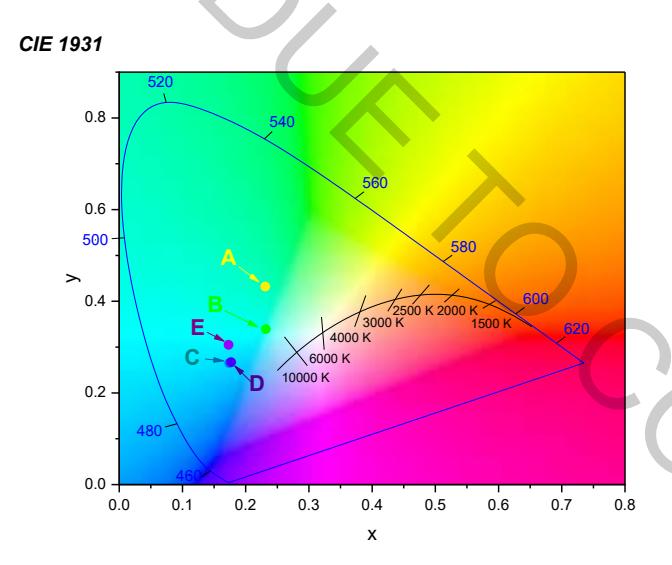
Electroluminescent characteristics of the studied compounds were tested in non-doped TADF OLEDs (marcked as device A-E) using them as emitters. The fabricated devices were characterized by blue/sky-blue electroluminescence with CIE1931 coordinates of (0.201,0.432), (0.232,0.339), (0.174, 0.265), (0.177, 0.267) and (0.173, 0.305) (Figure 1). In the best case using a multi-carbazole derivative substituted by two CN-moieties, devices showed maximum luminance of 36000 cd m-2, current efficiency of 19.5 cd/A, power efficiency of 6.1 lm/W and external quantum efficiency of 7.3%.