
A fuel cell is a device that generates an electric current between two electrodes through an electrochemical reaction. They undergo oxygen reduction at the cathode, and at the anode fuel oxidation and the resulting ions travel through the electrolyte. Solid oxide fuel cells (SOFC) are characterized by the use of oxygen-transported oxide as an electrolyte, the advantages of which are high efficiency, fuel flexibility, relatively inexpensive materials due to high operating temperature. However, these elements also have drawbacks, such as high operating temperatures, which reduce the durability of the element and make it difficult to seal the element between the two chambers [1].
A single-chamber solid oxide fuel cell (SC-SOFC) can eliminate some of the disadvantages mentioned, such as the cell's tightness due to its interesting structure. The SC-SOFC structure is made up of a single chamber traveling through a mixture of oxidizer and fuel. This chamber contains cathodes and anodes exposed to the same gas mixture, which makes it easier to seal the element [2]. However, this gas mixing has its own drawbacks, like parasitic combustion at the electrodes, which can raise the temperature, reduce the efficiency of the element or reduce the power density [3]. The work also showed that the constituent of the supplied mixture has a significant effect on the performance of SC-SOFC, and by choosing the right mixture, higher power can be obtained [4].
The aim of this work is to develop mathematical models and algorithm to simulate the kinetics of SC-SOFC mass transfer and catalytic processes and to predict how the optimal amount of CH4 gas in the mixture changes by changing the reaction rate constant of the cathode and anode.
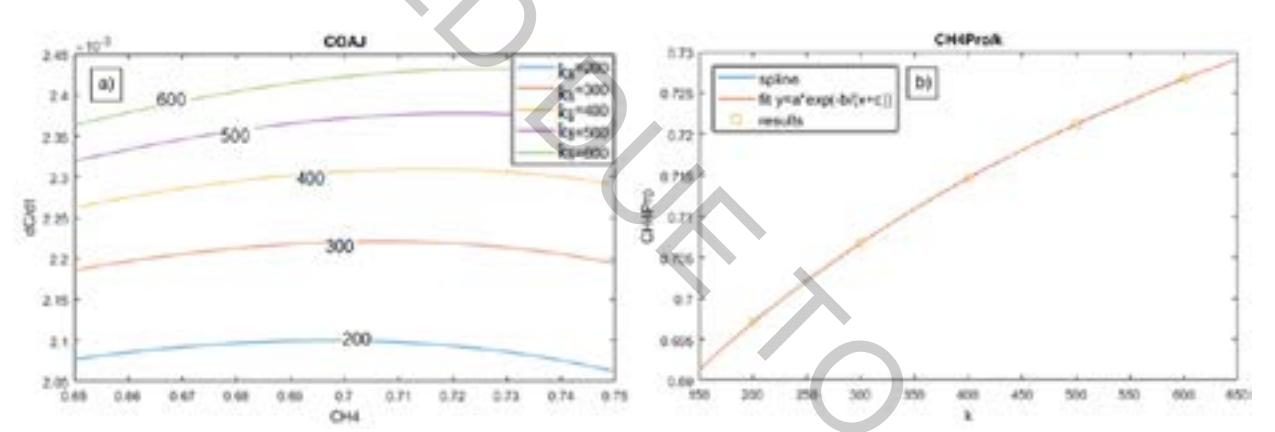
Using the resulting graphs, a mathematical formula was found that predicts the optimal proportion of CH4 in the gas mixture depending on the rate constant of the reactions. Eq. (1):
$$y = ae^{-\frac{b}{x+c}} \tag{1}$$From the results, it has been observed that as the rate constant of the cathode or anode increases, the CH4 fraction in the gas mixture must also be increased to obtain the highest diffusion rate. However, from the rate constant of the reaction to the cathode, it has also been observed that with the decrease of the methane fraction, it is preferable to use cathodes with a slower rate of oxygen decomposition.