
Gravitational microlensing phenomenon [1] is one of the most persuasive techniques to demonstrate the effectiveness of Einstein's general relativity [2]. The method relies on the space-time bending due to a massive object (e.g., black hole) and change in the trajectory of the light rays [3]. Resolving the images created during the lensing can lead to investigating massive astronomical objects, including black holes or planets, no matter how faint they are [4]. This gives a unique opportunity to investigate black holes lenses [5], different scenarios of their formation, in conjunction with the explanation of the nature of the dark matter and stellar evolution [6].
Gravitational microlensing phenomenon due to massive objects can be investigated with the ground-based astronomical instruments, however, one of the biggest issues with the ground-based observations is that the photon wavefront coming to the telescope is distorted due to atmospheric turbulence. It is caused by multiple atmospheric layers [7] which have different wind speeds and directions, also including absorption and scattering of the particles [8] in the atmosphere.
The easiest way to eliminate such instabilities and achieve high-resolution images is to use the Adaptive Optics (AO) system in telescope's interferometer that is able to correct distorted wavefront by collimator and deformable mirrors. It makes the wavefront planar that is detected by Shack-Hartman wavefront sensor [9].
In this research, we used ESO’s VLT (Very Large Telescopes system) interferometric instrument NaCo [10] which is capable to provide multimode, corrected observations by AO system in the range of 1-5 μm. AO system performance possesses 50% Strehl ratio (SR) under good atmospheric conditions and good correction the K-band corresponds to an SR larger than 30% [10].
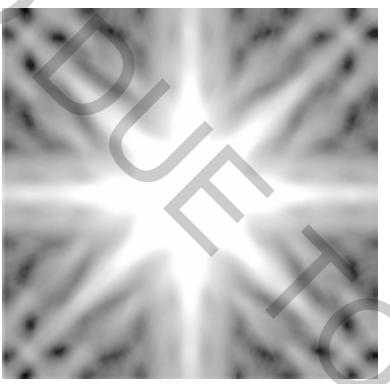
Using soapy [11] we simulated the point spread function (PSF) of NaCo. We created a set of artificial images of two point sources - a lens and a star, with varying separation and magnitude difference. We then convolved the artificial images with the PSF, which resulted in simulated NaCo images (in Fig. 1). Studying the shape of the simulated images and comparing it with the real NaCo image allowed us to determine whether a potential lens would be visible and to constrain its parameters.
In resume, by using NaCo and gravitational microlensing phenomenon, we hope to find Black Hole candidates.