Nowadays organic semiconductors get a lot of interest from researchers and manufacturers because of their wide range of applicability in medicine, textile but mostly in electronics[1]. Organic light emitting diodes (OLEDs) are already used in smartphones, tablets and computers displays also for illumination[2]. Another application which gains interest is sensors with organic materials. There are publications about organic semiconductors with room temperature phosphorescence (RTP), which are used as oxygen sensing materials[3]. Still, there are endless applications for these materials, which are created every day.
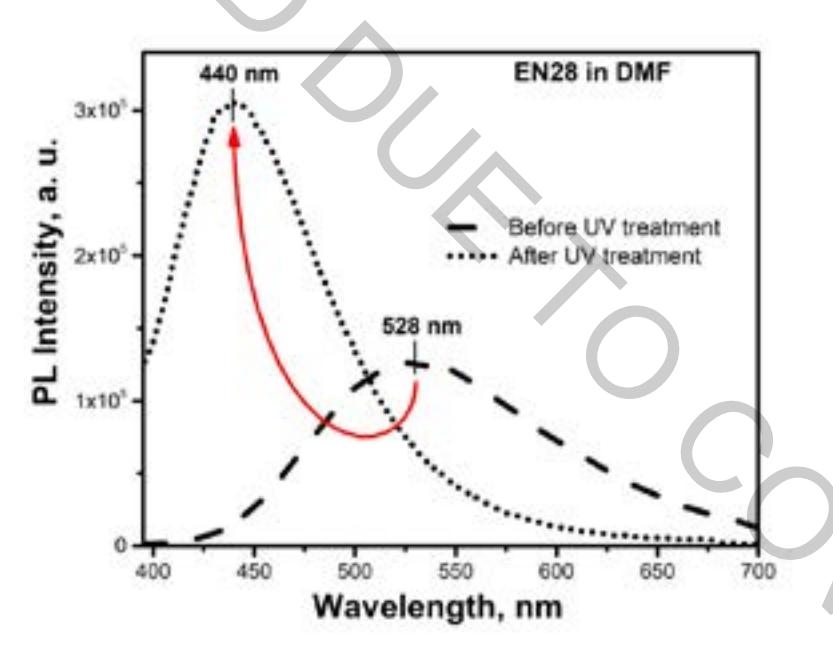
In this work we present novel organic semiconductor with phenothiazine and benzophenone derivatives, EN28, and intensive photophysical investigation of it. Materials EN28 shows thermally activated delayed fluorescence, but EN28 also shows properties of ultra-violet (UV) light enhanced photoluminescence (PL) emission. PL emission of toluene solution of EN28 (emission maxima 413 nm) gets more intensive as it gets illuminated by UV light longer. Also, the PL intensity increases faster as EN28 get illuminated by more intensive UV light. The PL of more polar solutions goes from lower energy wavelength to higher energy wavelength emission (solution in DMF goes from 528 nm to 440 nm) after UV treatment (Fig. 1). The increasement of intensity and PL shift to higher energy wavelength range are explained by conformational changes in the molecule induced by UV light photons. This unique property of EN28 can be used for UV light sensing.