
Because of environmental regulations against high amounts of lead used in ferroelectric materials (RoHS directive in EU) a lot of studies have been done in order to find the best lead-free alternatives. Na0.5Bi0.5TiO3 (NBT) based compositions contain quite large dielectric values and high electromechanical strain [1]. One of the most prominent techniques to create multi-layered ceramic structures is tape casting. This technology can provide high quality, large-area and thin functional materials such as ferroelectrics, piezoelectrics for multilayered capacitors [2]. Tape casting is mostly based on non-aqueous solvent but aqueous-based tape casting is also used as simple and eco-friendly method.
In this work NBT was doped with Yb (Y) and the mains task was to investigate the change of dielectric characteristics by changing bismuth concentration. There were two compositions with different bismuth concentrations: first composition had 49.82 % of bismuth and the other one had 46.79 %. Thick films were produced via an aqueous tape casting method. Dispex AA4040 was used as a surfactant and PVP solution (Luvitec K 90 Pulver) as a binder. Both chemicals were provided by BASF. Two step 500 °C and 1200 °C (2 h) thermal treatment on platinum substrate followed the casting and drying. Resulting films were of 170 μm thickness. Dielectric properties were measured at a temperature range 30 K - 750 K on cooling with a rate of 1 K/min. Also, electromechanical properties were investigated using commercial aixaCCT TF 2000 analyzer.
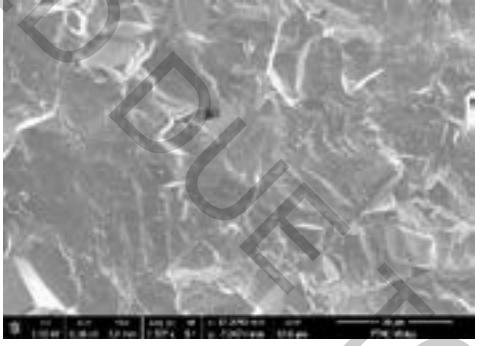
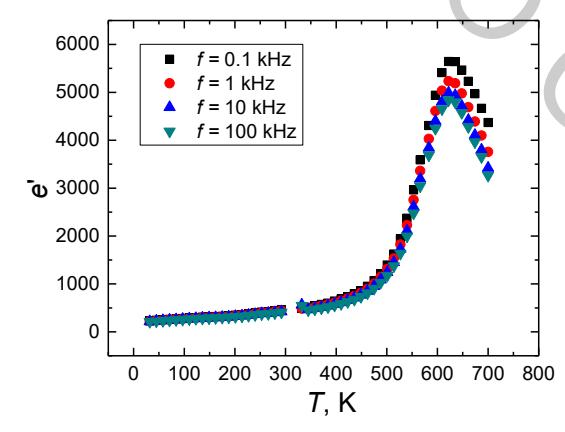
Fig. 1 shows SEM image of NBYT thick film with 49.82 % of bismuth. This image shows that film is quite dense because there are just a few pores on surface. Fig. 2 shows temperature dependence of dielectric permittivity of concentration which has 49.82 % of bismuth. From this dependence it could be determined that phase transition occurs at a temperature of 630 K. This phase transition is from paraelectric phase to ferroelectric. No other dielectric anomalies were observed at lower temperatures.