
Photoelectrochemical (PEC) water splitting has been considered as one of the most promising technologies in clean and renewable energy production. Numerous semiconductor materials have been intensively studied as photoelectrodes in PEC systems. Among them tungsten trioxide (WO3) nanomaterials have received considerable attention due to the ability of capturing 12% of the solar illumination with band gap energy of around 2.5-2.7 eV, high crystallinity, porosity, moderate hole diffusion length, good chemical stability, low cost and low toxicity [1-3].
In this study, nanostructured layers of WO3 on fluorine-doped tin oxide (FTO) substrate were formed by sol-gel method. Six different reductants have been used to investigate their influence on photoelectrochemical activity and properties of WO3 photoanodes. Peroxytungstic acid (PTA) was synthesized using sodium tungstate (Na2WO4 x 2H2O), HCl and H2O2 as precursors and (NH4)2C2O4 as capping agent. Subsequently, methanol, ethanol, propanol, isopropanol, butanol or acetic acid was added separately as reductant, which slowly and controllably reduced peroxotungstates to form uniform and ordered WO3 H2O films on FTO under soft water bath conditions at 85°C. After coating procedure, samples were annealed at 500 °C for 2 h with heating rate of 1°C/min to obtain a crystalline nanostructured WO3 films and to remove residual carbon. The crystallographic structure of the calcined WO3 films was characterized by X-ray diffraction (XRD) and photoelectrochemical behaviour of the samples was investigated by cyclic voltammetry (CV) (Fig. 1).
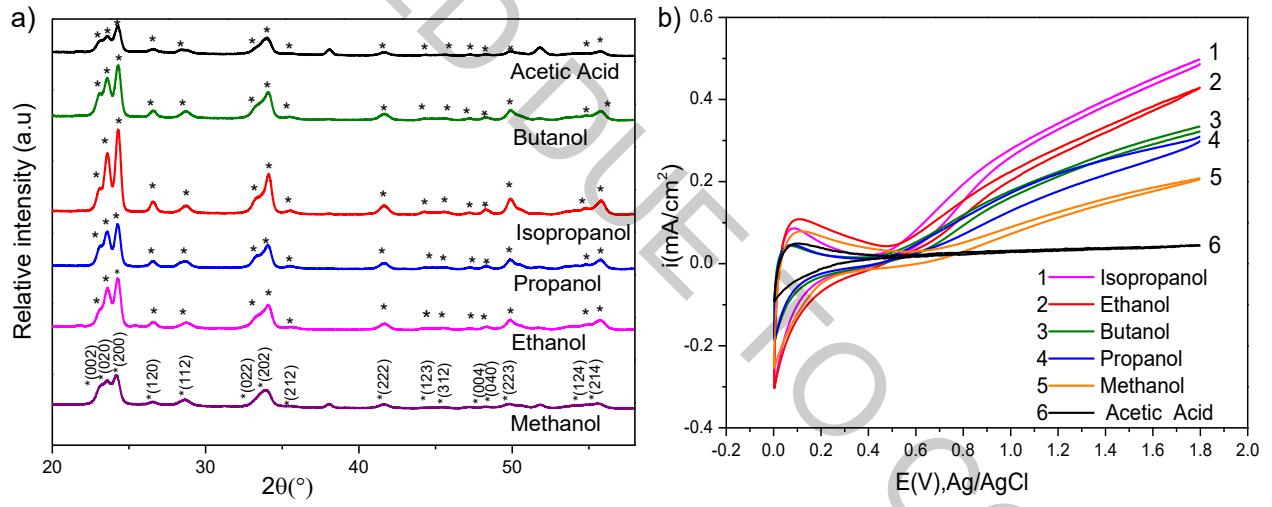
Fig.1(a) shows the XRD patterns of six WO3 samples using six different reductants. Notably, all the samples have the same peaks at $23.13^{\circ}$, $23.56^{\circ}$, $24.33^{\circ}$, $26.5^{\circ}$, $28.6^{\circ}$, $34.09^{\circ}$, $41.65^{\circ}$, $44.38^{\circ}$, $45.5^{\circ}$, $47.18^{\circ}$, $48.15^{\circ}$, $49.88^{\circ}$, $54.73^{\circ}$, $55.83^{\circ}$ corresponding to (002), (020), (200), (120), (112), (202), (222), (123), (312), (004), (040), (223), (124), (124) reflections of monoclinic WO3 structure (COD Entry. 96-210-6383). WO3 films formed with isopropanol as a reductant shows the most intensive peaks in the whole range of 2θ which is attributed to the highest crystallinity.
Cyclic voltammograms of FTO/WO3 photoanodes recorded in 0.5 M H2SO4 under illumination represent typical response of WO3. Using isopropanol as a reductant in the reported synthesis has been found to be the most effective route to increase the photoelectrochemical activity of WO3 photoanodes, as these films showed the highest photocurrent density at 1.8 V vs Ag/AgCl among the tested samples. Photoelectrochemical activity of FTO/WO3 electrodes prepared with six different reductants decreased in the following order: isopropanol > ethanol > butanol > propanol > methanol > acetic acid.
Correlation between PEC activity and morphology, structure, phase composition of sol-gel derived WO3 films will be elaborated at the conference.