Chemotherapeutic agents have the nonspecific toxicity and can affect healthy cells that leads to various side effects in the cancer treatment. Also, drug resistance in malignant tumors often complicates the treatment. Proapoptotic anticancer small interfering RNAs (siRNAs) can reduce the effective dose of drugs and can decrease the side effects. For efficient delivery siRNAs into cells the different carriers are used including nanocarriers such as nanoparticles, quantum dots, liposomes, dendrimers. Dendrimers, which are spherical hyperbranched polymers, proved themselves as effective carriers for DNA and siRNA delivery.
The aim of this work was to study the efficiency of combined use both dendriplexes (complexes of dendrimers and siRNAs) and doxorubicin – anthracycline antibiotic that used to treat many types of cancer, including acute lymphoblastic leukemia, cervical cancer, etc. Studies were performed using three cell lines: HT29, HeLa and HL-60.
To study the internalization of dendriplexes, the non-targeting FITC-labeled siRNAs were used. SiRNAs were complexed with third generation cationic phosphorus dendrimers and incubated with studied cell lines for 3 hours. Level of internalization was measured by flow cytometry (CytoFLEX, Beckman Coulter). The cellular uptake of complexes was 70% for HT29 cell line, 83% for HeLa and– 98% for HL-60.
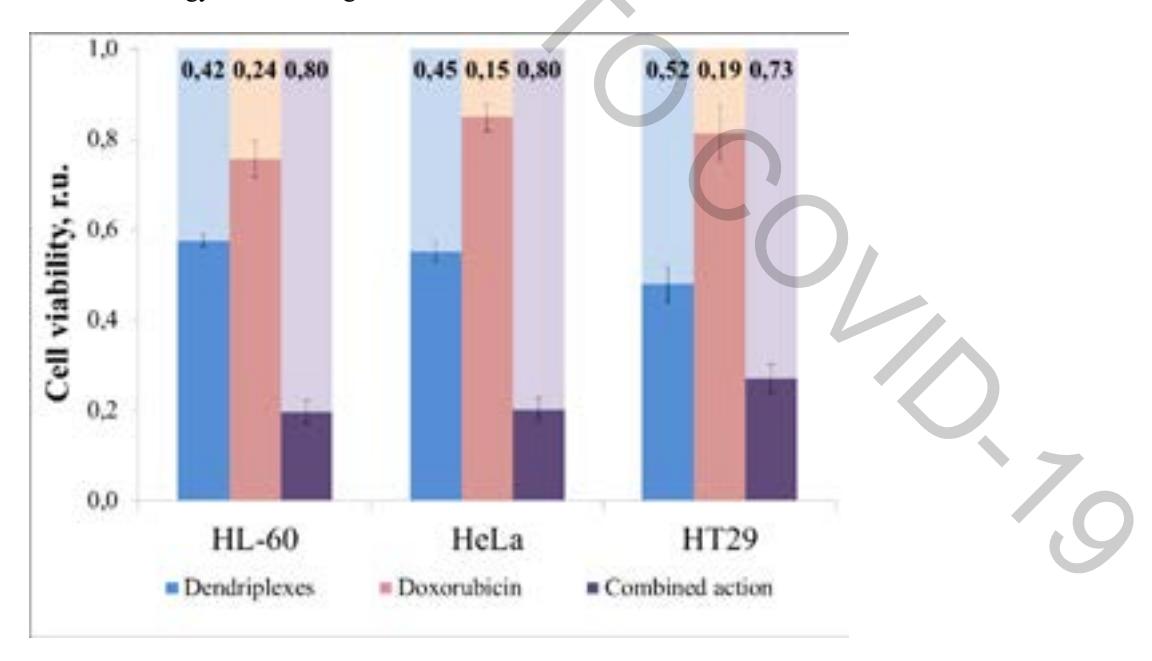
For detection of the cytotoxicity of dendriplexes and doxorubicin the cell viability tests were used. Concentrations of doxorubicin were 0.1, 1 and 10 μM for HL-60, HeLa and HT29 respectively. Dendrimers were complexed with siRNAs siBCL-xL (HL-60, HT29) and siMCL-1 (HeLa), which silences genes of corresponding antiapoptotic proteins BCL-XL and MCL-1. The dendrimer/siRNA charge ratio was 10:1. Cells were treated with complexes and doxorubicin for 24 hours. After incubation, cell viability was measured by Alamar Blue assay for suspension cells (HL-60) or MTT-test for adherent cells (HeLa, HT29). As a result of the combined action of doxorubicin and dendriplexes cell death was 80% for HL-60 and HeLa (Fig. 1). This effect is higher with a statistically significant difference than the sum of the effects of the components per se, which means the presence of a synergistic effect. For HT29, no significant difference was observed and the effect of combined action is additive.