
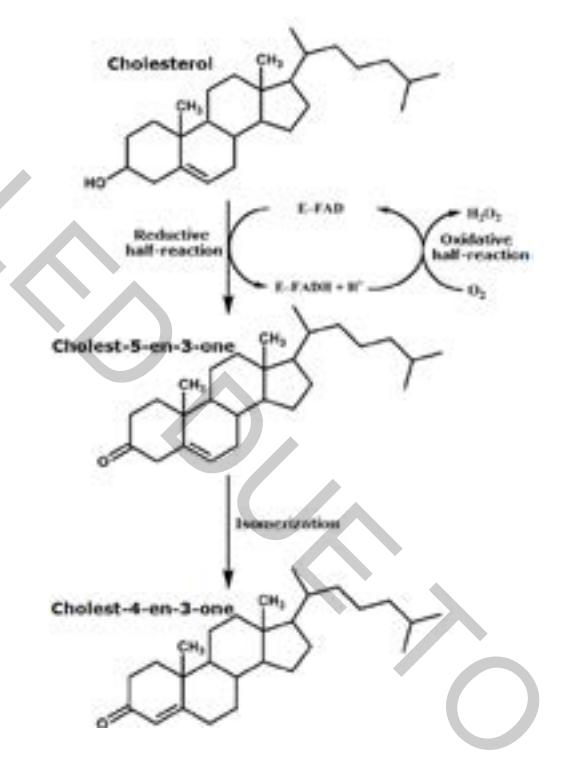
Cholesterol serves as a precursor for the synthesis of various steroid hormones, bile acids, vitamin D and other biologically active substances in the human body. The determination of serum cholesterol is used in diagnostics for the assessment of atherosclerosis or coronary heart disease, estimating the risk of thrombosis and cardiovascular disease. Cholesterol oxidase is a group of enzymes that catalyzes conversion of cholesterol to cholest-4-en-3-one (Fig. 1) [1]. These enzymes are widely employed by laboratories for the determination of cholesterol concentrations in clinical samples, food and others, in enzyme-assisted derivatization for sterol analysis (EADSA) in combination with LC-ESI-MS analysis [2,3]. These enzymes are used as biocatalyst for steroid drug production.
Among other things, microbials cholesterol oxidases are a pathogenicity factor and can be considered as potential targets in antibiotic therapy [4]. Thereby all of the above indicates the necessity to obtain recombinant forms of cholesterol oxidases and to conduct its structure-function relation.
Thus, the biosynthesis and investigation of cholesterol oxidases from Pseudomonas aeruginosa and Streptomyces lavendulae are an important aid for development of new biosensors and for antibiotic therapy.
We obtained cholesterol oxidases from Pseudomonas aeruginosa PAO1 and Streptomyces lavendulae and established the physicochemical properties of these proteins and the features of enzymatic catalysis. In addition, we characterized the catalytic activity of these enzymes, established the products of catalysis and suggested structural determinants of enzyme specificity.