
Intermediate Mass Black Holes (IMBHs) are hypothetical missing building blocks of larger black holes, Super-Massive Black Holes (SMBH), which are found in the centres of galaxies [1,2]. The left-over population of IMBHs should be discoverable in the present Universe, however, current attempts resulted only in weak candidates [3].
Firstly, we have to rely on the unique and up-to-date methods that can find, explore and quantify the traces of IMBHs. Among the most persuasive techniques, the Gravitational Microlensing phenomenon [4] becomes a very powerful probing technique which can be used to study the structure of the Milky Way no matter how faint objects are [5]. This method is based on Einstein's general relativity theory which means that incoming light wavefront can bend around massive object (e.g., black hole) as a consequence of its gravity when so called "lensing star" is passing by [6].
However, missing piece of information in microlensing is the separation between the lensed images, as they are of order of milliarcseconds. First high resolution imaging of microlensed images was obtained with ESO's (European Southern Observatory) VLTI (Very Large Telescope Interferometer) instrument GRAVITY [7]. Nevertheless, to get more information and details of our desired astronomical object, we must have telescope with bigger diameter in order to reach to more common but weaker sources. The bigger the telescope, the higher angular resolution that we can get. ESO's E-ELT (Europe's Extremely Large Telescope) will be the biggest "eye" on Earth in 2025 with 39.3 m diameter primary segmented mirror [8].
In this research, we are presenting the capabilities of detecting IMBHs with E-ELT first light imager MICADO (Multi-Adaptive Optics Imaging Camera for Deep Observations) (the set-up is showed in Fig. 1). By applying, multi-adaptive optics systems, we can be able to resolve images without a huge impact coming from atmosphere but the we must to get a proper calibration of the instrument. This work will present the factors that determine the difficulties faced by the calibration.
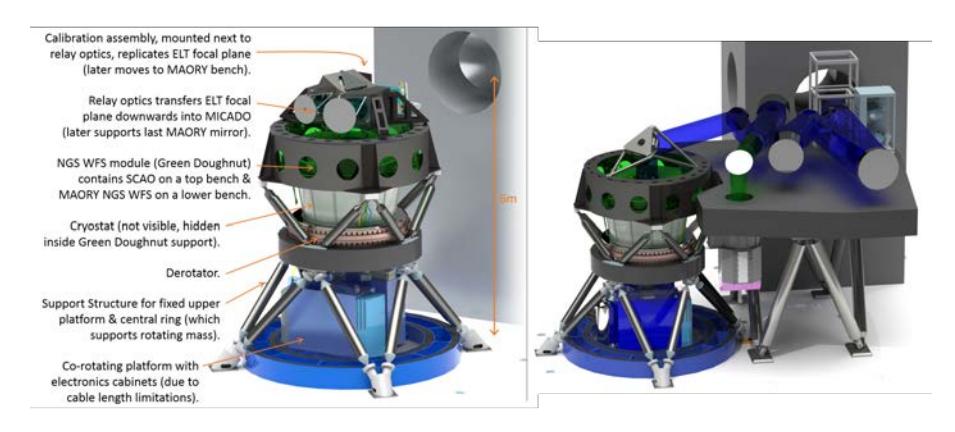
In summary, MICADO will be able to perform high resolution (5 - 12 milliarcsec) near infrared observations and it is very promising future instrument to detect microlensed candidates of IMBHs. In the future, we are hoping to simulate the probability of IMBHs candidates with milliarcsec resolution of MICADO and get required spectroscopic information from the research that we presented.