Additive manufacturing is getting popular in the manufacturing companies, because it is a cheap and fast way to produce new products in complex shapes [1]. Additive manufacturing provides such benefits as lower material loss, reduced product weight and possibility to print spare parts without using fixtures or molds [2,3].
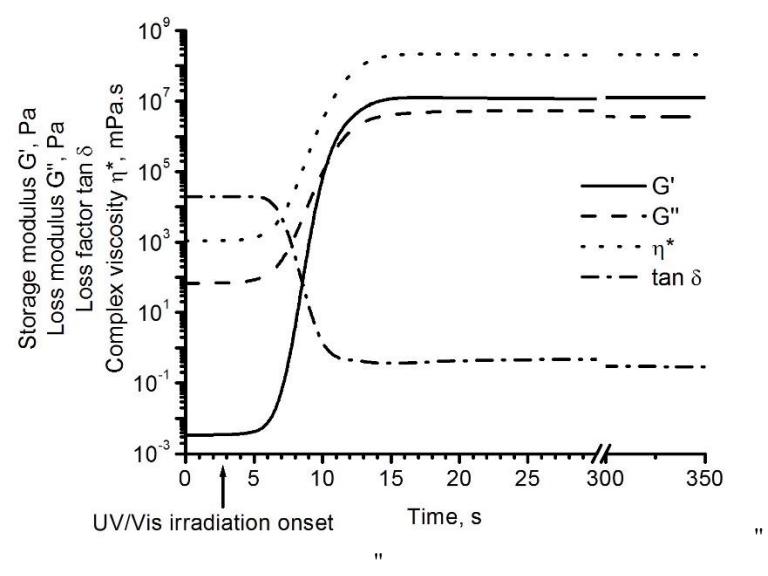
In this study, cross-linked polymers were obtained by photopolymerization of vanillin diacrylate and vanillin dimethacrylate with 1 or 0.5 mol.% of 1.3-benzenedithiol, using phenylbis(2,4,6-trimethylbenzoyl)phosphine oxide (BAPO) as photoinitiator. Photorheometry was used to monitor the evolution of photocross-linking process. The UV/Vis real-time photorheometry curing tests were performed on a MCR302 rheometer from Anton Paar equipped with the plate/plate measuring system. Dependencies of storage modulus G', loss modulus G'', loss factor tanδ, and complex viscosity η* of pure vanillin diacrylate-based resin with 3 mol.% of BAPO on irradiation time is presented in Figure 1. It was determined that the addition of solvent into the resin slowed down the photocuring process and less rigid polymers were obtained. The addition of thiol increased the photocuring rate but reduced the rigidity of the resulting polymers.
Fig. 1. Dependencies of storage modulus G', loss modulus G'', loss factor tanδ, and complex viscosity η* of pure vanillin diacrylate-based resin with 3 mol.% of BAPO on irradiation time, at 25 °C.
Vanillin-based polymers showed significant antibacterial activity against Escherichia coli and Staphulococcus aureus in direct contact and on medium. Toxicity to microscopic fungus Aspergillus niger and Aspergillus terreus was less pronounced.
Acknowledgments: This research was funded by the EU ERDF, through the INTERREG BSR Programme, (ECOLABNET project #R077), the European Social Fund under the measure no. 09.3.3-LMT-K712 "Development of Competences of Scientists, other Researchers and Students through Practical Research Activities", and the Research Council of Lithuania (project no. S-MIP-20-17).
[1] M. K. Niaki, S. A. Torabi, F. Nonino, Why manufacturers adopt additive manufacturing technologies: The role of sustainability, J. Clean. Prod.222, 381-392 (2019).
[2] D. Böckin, A.-M. Tillman, Environmental assessment of additive manufacturing in the automotive industry, J. Clean. Prod.226, 977-987 (2019).
[3] A. Chergui, K. Hadj-Hamou, F. Vignat, Production scheduling and nesting in additive manufacturing, Comput. Ind. Eng.126, 292-301 (2018).