
In the last decade interest in ZnO markedly recur and increase. This outstanding popularity is due to ZnO multi-functionality, suitable for various applications [1]. Depending on the method of synthesis, the structure and morphology can be greatly modified, resulting in changes in physical and chemical properties.
Our aim was to investigate ZnO morphology (size, shape, porosity) on electrochemical properties.
Experimental approach. Tetrapods were synthesized using combustion method [2] and separated by centrifugation into 2 size fractions (large tetrapods – 1000 RPM, named LT; small tetrapods – 3000 RPM, named ST).
Electrochemical properties (active surface area A, electron transfer rate AEp) were evaluated using cyclic voltammetry measurements of 100 μm K4[Fe(CN)6] dissolved in 0.1 M KCl solution. Working electrode (WE): glass substrate →100 nm Au, → ZnO tetrapods. Ag/AgCl reference electrode (RE) of 2 mm in diameter and Pt counter electrode (CE) of 0.5 mm in diameter Figure 1.
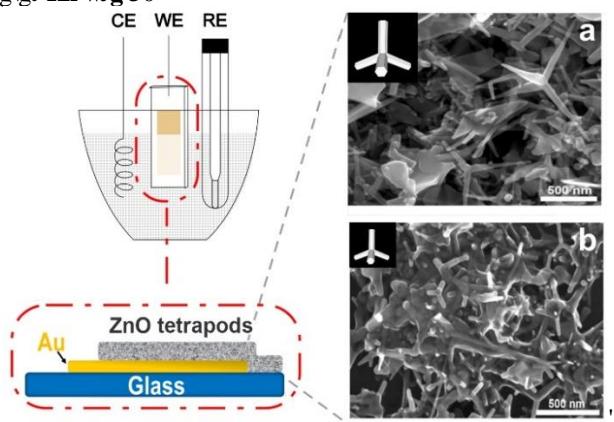
Techniques used: resistance measurement, Scanning and Transmission electron microscopies (SEM and TEM), X-ray powder diffraction (XRD), UV-Vis spectroscopy.
Structure and morphology. It was noted both LT and ST tetrapods form a typical tetrapod structure consisting of 4 connected nanorods:
small tetrapods (ST) diameter 5 nm, length 50 nm;
large tetrapods (LT) diameter 20 nm, length 150 nm;
Moreover, it was found that nanorods (legs) are well-defined interference fringes corresponding to ZnO (10\bar{1}0) planes.
Electrochemical properties. It was distinguished that the electrochemical reactions of ZnO nanostructures are influenced by two simultaneous mechanisms:
ZnO nanostructures under different potential;
ferricyanide on the ZnO electrode.
It was concluded that due to the one-dimensional leg arrangement tetrapods showed great electrochemical properties. The effect is more pronounced for longer leg tetrapods (LTs), leading to peak separation $\Delta E_p$, approaching the theoretical value. Though, LT that has the biggest active surface (0.095 cm2) and its practical AEp value of 61.7 mV, which is close to the theoretical 59 mV.
These results are significant for the upcoming ZnO tetrapods applications in electrochemistry, where the morphology influence on the properties should be considered [3].