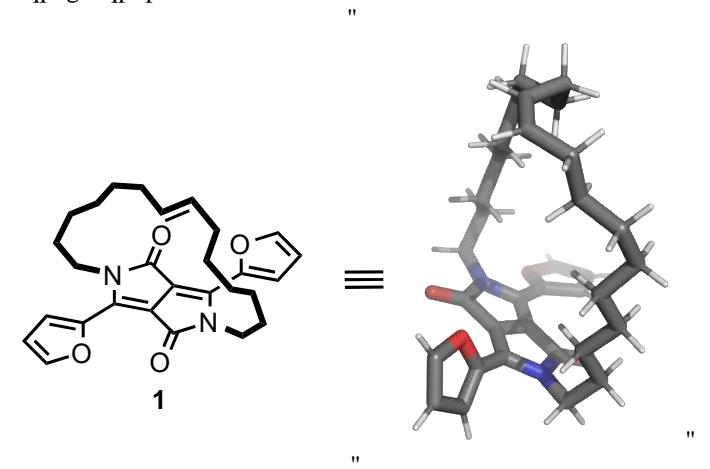
Triplet fusion (TF) upconversion is a process allowing the conversion of two or more low-energy photons to one high-energy photon. Light upconverting systems have great implications in many fields, such as photovoltaics, photocatalysis or bioimaging. Despite a large demand, the choice of efficient organic materials is rather limiting, especially for the most practically relevant NIR to visible upconversion [1-2]. TF upconversion requires two types of molecules, a sensitizer and an annihilator, the latter often being the limiting component. To extend the collection of possible emitters and to gain fundamental insights into upconversion process itself our team sought to develop new derivatives of diketopyrrolopyrrole (DPP), a commonly used dye in organic optoelectronics.
DPP has been widely explored in the field of organic photovoltaics because of its excellent optical properties, such as strong absorption in the visible range and high fluorescence quantum yield [3]. In order to apply DPPs in upconversion devices, their high aggregation propensity, detrimental to fluorescence, has to be attenuated by structural design. To this end we have designed, synthesized and evaluated new alkyl chain strapped sterically hindered DPP derivative 1 (Fig. 1). The successful modulation of aggregation process is expected to provide a working material not only for solution but also for more difficult to achieve upconversion in films.