Photonic crystal fibers (PCFs) are different from conventional optical fibers, because PCFs have a periodic microstructure region inside them where light is propagating [1]. Solid core PCFs are perfect nonlinear media, in which it is possible for nonlinear processes to occur due to third order nonlinearity [2]. Third order susceptibility $\chi^{(3)}$ is related to optical Kerr effect, which leads to several nonlinear processes such as pulse self-phase modulation, cross-phase modulation, four-wave mixing or even stimulated Raman scattering, which results in pulse spectral broadening [3].
In this study we present experimental results of our investigation of UV – VIS light generation in photonic crystal fiber pumped by IR 110 fs pump pulses. The pump source for UV – VIS light generation was Yb:KGW laser “Flint” oscillator generating 1028 nm wavelength with repetition rate of 75.2 MHz and 110 fs duration pulses. A beam splitter, which transmits 35% of energy and reflects 65% of energy, was used to divide the radiation into two beams. The beam with more energy was used as a reference pulse for cross-correlation frequency-resolved optical gating (XFROG) measurements and the other beams with less energy was used for the generation UV – VIS light in PCF. Polarization maintaining solid core PCF with high nonlinear coefficient and zero dispersion wavelength of 1040 nm was used. PCF length was 2.6 cm and core diameter - 4.3 μm. XFROG measurements were performed by non-colinearly focusing reference radiation and light from PCF into 300 μm thickness BBO crystal, which was cut at $\phi$=0° and $\theta$=30° for type II phase matching. By changing delay of reference pulse sum frequency radiation spectrum was measured and a joint representation of delay time and spectrum was obtained XFROG spectrograms.
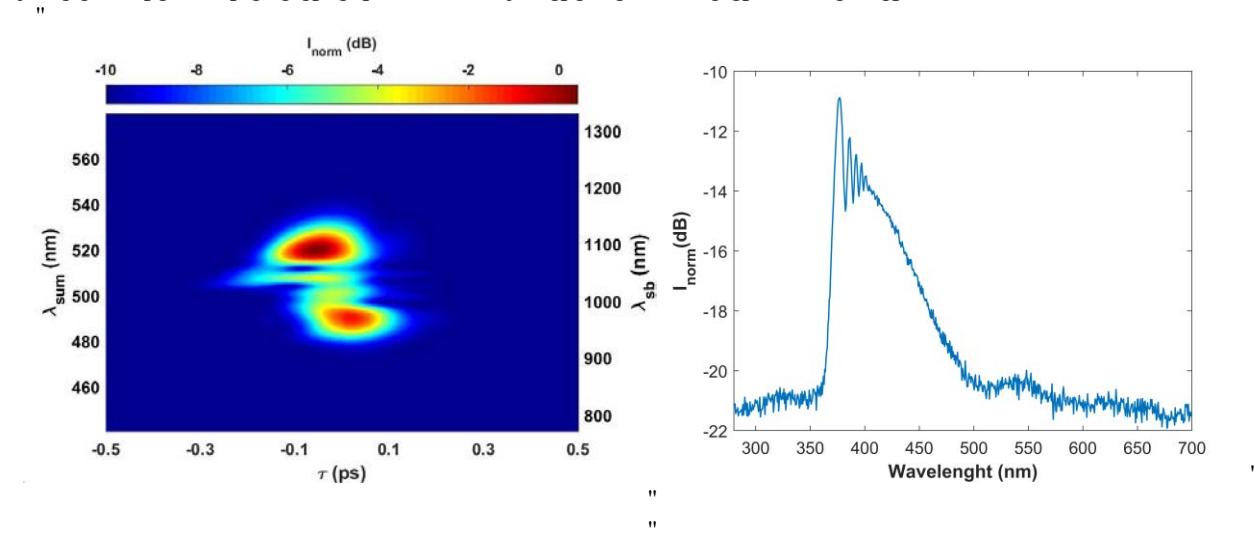
In this report it is shown, that when IR pump pulse of 110 fs duration and central wavelength of 1028 nm is seeded into PCF, pulse spectrum broadens from 900 to 1200 nm, which can be seen from retrieved XFROG trace (Fig. 1). A small pulse broadening is caused due to short PCF length (2.6 cm) and such spectrum broadening can be explained based on nonlinear process such as self - phase modulation. Furthermore, spectrum measured at PCF output showed that alongside of pulse spectrum broadening in IR range, a generation of weak UV-VIS wavelength range was also observed. The bandwidth of such spectral range was from 350 to 500 nm and several oscillations were observed (Fig. 1), which might be explained by interference of UV-VIS light generated at different PCF segments.