
Plants are well adapted to grow in a certain range of environmental conditions. One of the most important environmental factors influencing plant growth is the pH of their growth medium. [1] Different plant species and cultivars vary by pH range they can grow without restriction and cytotoxic/genotoxic damage. This research aimed to determine pH range in which common onions (Allium cepa L.) can grow without experiencing toxic and genotoxic effects and whether the response of different onion cultivars to varying pH is similar.
pH toxicity was determined using Allium cepa root growth inhibition test where onions were grown in an interval of 2 -12 pH for 96 h. “Aleph,” and “Sturon,” cultivars were used. Mean root length in root bundle and root morphology were evaluated. Hereafter, genotoxicity of pH was assessed analyzing onion root meristemic cells which were grown in pH solution that is equal to EC50 for both acidic and basic mediums 3.5 and 10.5, respectively. Tap water and 10 mg/l MMS solution were used as a negative control (NC) and positive control (PC), accordingly. Cells were evaluated microscopically using anaphase-telophase chromosome aberration assay after 24 h exposure and micronuclei assay after 24h recovery period along with the determination of mitotic and phasic indices. Statistical analysis was done using two-way ANOVA following Tukey post-hoc test.
Root growth was inhibited and root morphology changed in extreme pH solutions. Length of roots was maintained in 4-10 pH interval compared to NC and in 2 and 12 pH solution roots were up to 3-5 times shorter. Through entire 96 h growth period, in 4-10 roots grew at a similar rate, while roots exposed to highest and lowest pH did not grow at all. Different cultivar response to pH was the same in every solution, except in 10 pH. In a genotoxicity assay, most chromosome aberrations were found in water samples (Fig 1b.) but most micronuclei were found in the positive control (Fig. 1d). Mitotic activity was not remarkably increased or inhibited in different pH solutions and did not deviate in direct exposure and after a recovery. (Fig. 1a, c) Prophase was the most abundant phase in mitotic cells, but its rate has decreased after the recovery period where relative part of cells in other mitotic phases increased.
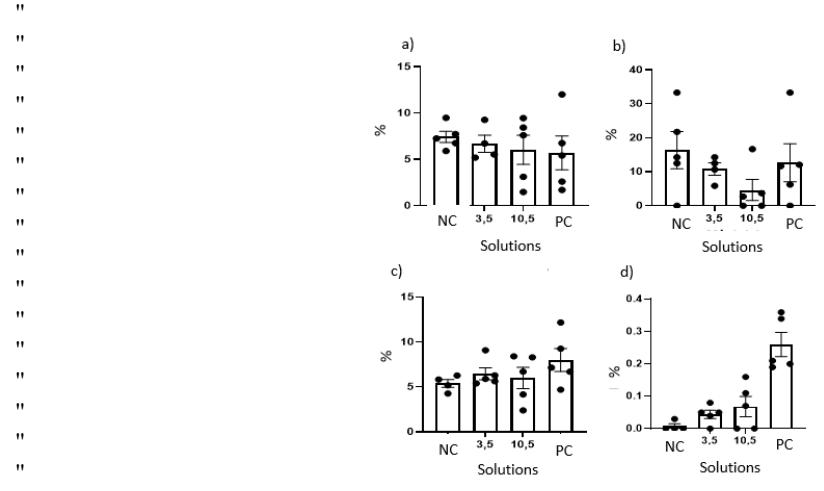
Low and high pH negatively affects onion root growth, probably because intrinsic pH regulation systems are disturbed. [2] Comparison of different cultivars showed almost similar in their response to varying pH. Chromosome aberration rate did not depend on solution pH and genotoxic damage was reversible because there was almost no formation of micronuclei. High frequency of chromosomal aberrations in onions grown in water can be explained by relatively low number of mitotic cells in anaphase - telophase. Cell division activity did not depend on solution pH. Phasic indices changed insignificantly and, during recovery, older cells that were in prophase could proceed further into the cell cycle.