
Gestational diabetes mellitus (GD) is a chronic hyperglycemia diagnosed during the 2nd trimester of pregnancy [1]. Despite the tendency to disappear after delivery, the prevalence of this disease is constantly growing in Lithuania and worldwide and correlates with the type 2 diabetes mellitus (T2D) as GD causes higher risk of T2D for the mother and her child [2, 3]. Therefore, it is important to elucidate molecular biomarkers for the risk evaluation of both GD and T2D development.
As epigenetic alterations show great perspectives as liquid-biopsy biomarkers [4], the aim of this study was to analyze 6 selected microRNAs – miR-16-5p, miR-27a-3p, miR-152-3p, miR-155-5p, miR-222-3p, and miR-518d-5p in whole-blood samples of women diagnosed with GD and to associate them with clinical GD indicators.
In total, 56 women (49 diagnosed with GD and 7 healthy pregnant women) were included in the study and 108 samples were tested. Blood samples were taken at 24–28 weeks of gestation (n = 39), at 6–12 weeks after delivery (n = 12), and also from the umbilical artery (n = 26) and vein (n = 26). The selected miRNAs were quantified by means of quantitative PCR using TaqMan-based assays after reverse transcription (RT) of all miRNAs.
Higher amounts of miR-16-5p, miR-152-3p, miR-155-5p and miR-222-3p were detected in the blood of GD women after delivery compared to the gestational period (all p < 0.05). Also, higher levels of miR-16-5p, miR-27a-3p and miR-152-3p were detected in the blood of GD women after delivery as compared to healthy not pregnant women (all p < 0.05; Fig. 1). The miRNA levels did not differ between the GD and non-GD women in blood during gestational period (all p > 0.05). MiR-518d-5p was detected only in blood from the umbilical artery. The amount of miR-16-5p in GD women during gestational period was associated with body mass index before pregnancy, while miR-27a-3p and miR-155-5p correlated with plasma glucose levels (all p > 0.05). Furthermore, the blood level of miR-155-5p after delivery was associated with women's age (p = 0.017) and similar tendencies were observed regarding miR-16-5p and miR-222-3p in blood from the umbilical vein.
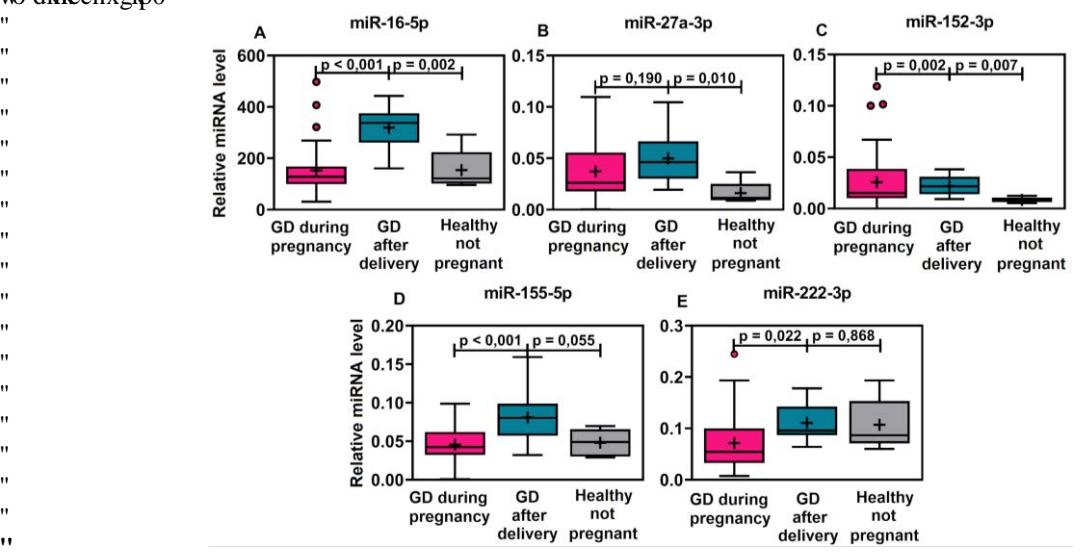
This study showed various associations between the levels of analyzed miRNAs in the blood of GD women and their clinical indicators, indicating their potential for GD and T2D diagnostics and / or prognosis. However, comprehensive studies in larger cohorts are needed to validate these miRNAs as potential GD biomarkers.