Irradiation of transparent materials with femtosecond laser pulses at high repetition rate induces so called self-organized quasiperiodic nanostructures at its surface [1]. In addition, this type of material modification depends on the exposure time or a number of accumulated laser pulses. Low exposure time produces quasiperiodic structures, the so-called nano-ripples. By further increasing the exposure time, the formation of microgrooves can be observed. In this case, the nanostructures reminds the cornflake-like structures with quasiperiodic ordering. In the sequel, the higher exposure time is responsible for the formation of another type modification – laser induced periodic annular surface structures (LIPASS), containing the damage crater in the center and superimposed periodic rings around [2]. Note that such transition is universal, observed in many dielectric bulk materials and can be applied in a broad range of applications including plasmonics, photonics and microfluidics [3].
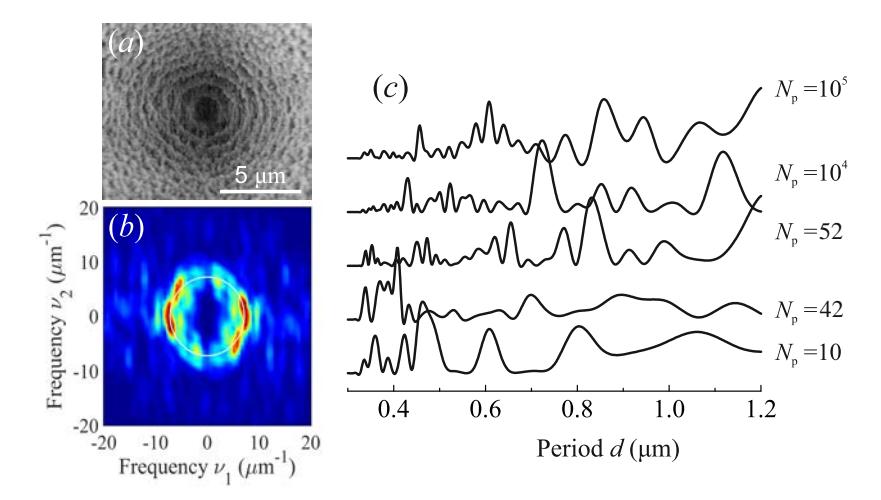
In this work we investigate the laser-induced periodic nanotructures at high repetition rate of femtosecond laser pulses in sapphire, YAG, MgF2 and fused silica. The experiments were performed using Yb:KGW laser (Pharos, Light Conversion), with 180 fs FWHM pulse duration, operating at 1035 nm central wavelength and repetition rate of 200 kHz. To investigate laser induced structural changes we used PrismaSEM scanning electron microscope (SEM). Fig. 1 (a) shows SEM image of LIPASS on sapphire surface irradiated by 104 consecutive pulses and Fig. 1 (b) represents its frequency spectrum retrieved by 2D Fourier transform. The experimental results revealed that the formation of nanostructures in bulk materials is a universal process producing exposure time dependent periods of the structures as presented in Fig. 1 (c). By using the low number of pulses, high spatial frequencies are dominant, while the low spatial frequencies are obtained by irradiating with high number of pulses. In addition, such a behaviour can be observed in many other materials such as alkali metal-fluorides and fused silica. Furthermore, femtosecond laser pulses produces very similar structures in materials volume [4]. Such a phenomenon is accompanied by the appearance of the conical third harmonic (TH) indicating the multipulse optical damage [5]. Note that TH generation can be understood in the frame of four-wave mixing process, requiring to fulfill the transverse phase matching (PM) condition. Also, we show that such condition can be satisfied via reciprocal lattice vector involving the nanograting period. Indeed, the two-dimensional Fourier transform of the SEM image yields a broad distribution of nanograting periods, including the required period to satisfy the transverse the PM condition.