
Inorganic-organic composites are a quickly developing group of materials with a tremendous range of highly tunable structural, physical and chemical properties. High compositional variability of these materials allows incorporating variety of inorganic compounds. Of particular interest are composite materials with group IV-VI group binary chalcogenides, which possess unique physical properties of tremendous importance to modern science and technology. Among them, tin sulphide (SnS) has attracted the attention of many researchers because of its higher absorption coefficients (>104 cm-1) and the energy gap of ~$1.3$ eV [1]. It is made the composites with layer of SnS potential applicability in the field of solar energy conversion strategies [2]. In addition, SnS has great potential for use in memory switching devices, holographic recording systems and as an anode material for lithium batteries [3]. In this work for formation of tin sulphide layer on polyamide PA 6 sheets sorption/diffusion method in two stages was used.
Polyamide sheets attributed to the semi-hydrophilic polymer. Therefore, there is capable to absorb ions of various electrolytes from aqueous solutions. This fact allows sulfur anions with a low oxidation state to be introduced into PA sheets. Further treatment of sulfurized PA sheets with metal salts water solution leads to the formation of metal sulfide layers on the surface and matrix of the polymer sheets.
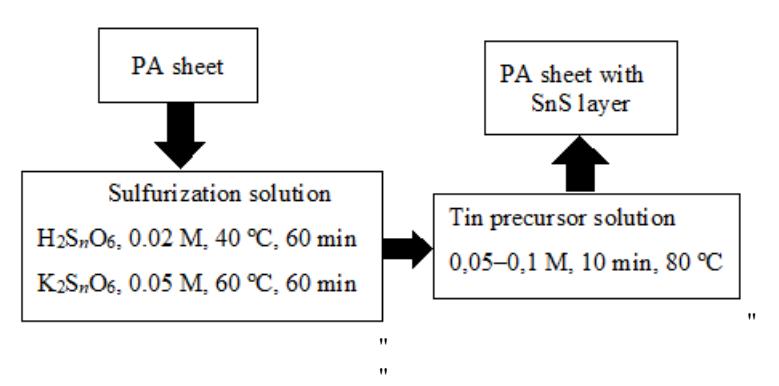
The aim of this study was to select the most suitable compounds for polymer sheet saturation with anions of low oxidation state sulfur as well as formed tin sulfide layers on polymer. Firstly, the pieces of boiled polyamide sheets (Tecamid 6, 500 μm thickness, Germany) 15×60 mm in size were treated in a thermostatic vessel for one hours in solution of sulfurization agent. As sulfurization agents we used the solutions of higher polythionic acids, H2SnO6 ($n = 5\div33$) and their potassium salts (K2SnO6). In the second stage the pieces of sulfurized PA sheets were treated with a solution of divalent tin precursor solution.
Structural and elemental composition of the obtained layers were investigated by atomic absorption spectroscopy (AAS) and X-ray diffraction (XRD) analysis.