Carbonic anhydrases (CA) are enzymes that catalyse reversible hydration of carbon dioxide (CO2 + H2O = HCO3- + H+). CAs are metalloproteins most of them contain zinc in their active centre. Multiple CA isoenzymes are widely expressed in different mammalian tissues, as they participate in pH regulation, CO2 and HCO3- transport, gluconeogenesis, lipogenesis, and other processes [1]. Different CA isozymes are recognized as drug targets for management of fluid secretion and pH change linked diseases. Mouse carbonic anhydrase XIV (Car XIV) is orthologous to human CA XIV protein, and is mostly expressed in brain, heart, and kidney tissues [2].
The aim of this study is to produce functionally active recombinant Car XIV protein. We constructed recombinant plasmid using vector pET-15b. This vector introduces N-terminal His6-tag to target protein to make purification of the protein more effective by using immobilized metal affinity chromatography. To confirm the DNA sequence of insert, plasmid was sequenced.
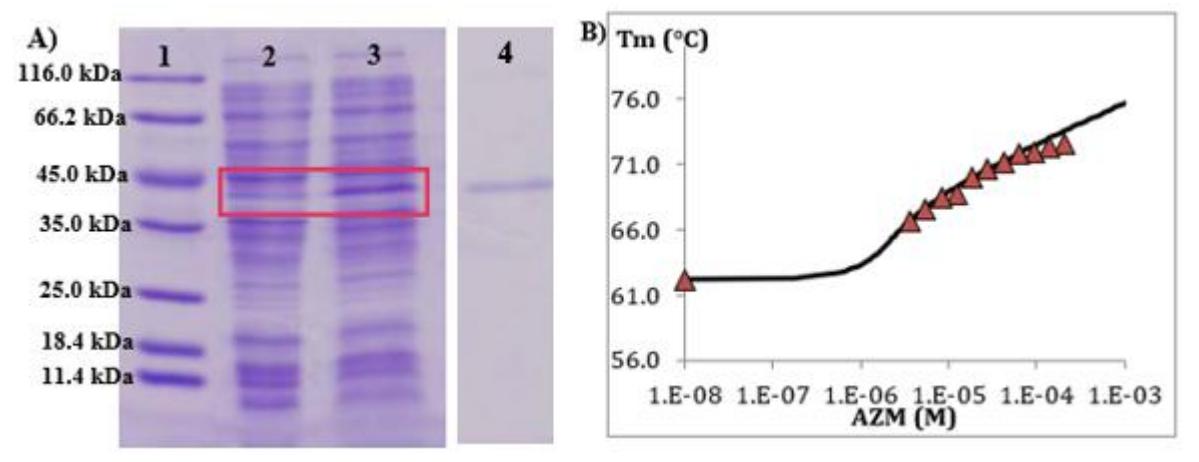
After careful selection of protein expression conditions, we obtained optimal expression of Car XIV in Escherichia coli Origami B (DE3) strain cultured in LB medium at 37°C until OD600=0.5-0.6 and then induced with 0.5 mM IPTG and 0.5 mM ZnCl2 and incubated at 16°C overnight. We used two-step affinity chromatography for Car XIV purification: immobilized metal affinity chromatography followed by purification using p-aminomethylbenzenesulfonamide-agarose. Expression and purity of Car XIV protein has been confirmed using SDS-PAGE (fig. 1 A).
Protein functional activity was confirmed according to its binding to CA-specific small molecule compounds, bearing unsubstituted sulfonamide group, using fluorescent thermal shift assay (FTSA). Unfolding of recombinant Car XIV protein exhibited single transition curves, typical for single domain globular proteins. Binding of small molecule ligands was confirmed by increased melting temperature of protein-ligand complex in a concentration-dependent manner (fig. 1B).