Nanofiber materials are characterized by high specific surfaces, advantageous for applications in the field of filtration, tissue engineering, etc. There are several methods of preparing polymeric nanofibers out of which electrospinning is the most used one. In this technology, fibres are formed due to electric forces created by means of electric potential difference between an electrode and a collector. Till now, two types of electrospinning have been developed: spinning in the constant electrical field "DC electrospinning" and spinning in the alternating electrical field "AC electrospinning" [1]. Unlike the first one, the AC electrospinning does not require any physical collector and the plume of nanofibers can be collected by various means, e.g. non-conductive rotating core yarn [2]. Ions emitted from the spinneret form a so-called "virtual collector" in its vicinity that works as a highly efficient collector for oppositely charged ions emitted in the next period [3]. Velocity of fibers drawn by electric field falls suddenly after reaching the area of the virtual collector. Even though some studies have been carried out [4], the behaviour of the virtual collector under different input signal conditions and its influence on fibres productivity has not yet been fully investigated.
This work focuses on analysis of fibre velocity in between the electrode and the virtual collector under various signal conditions. Furthermore, the aim is to design a new electrode capable of flat nanofibrous material production with appropriate signal parameters applied in order to improve the efficiency and homogeneity. For this purpose the laboratory AC electrospinning device was built. It comprises one or several thin rotary discs as a spinning electrode, see Fig 1. The device enables the setting of input electrical signals (waveform, amplitude, frequency and offset), while recording the fibres movement by high-speed camera. The effect of various signal parameters upon the collector distance R, fibres production and morphology was measured and analysed.
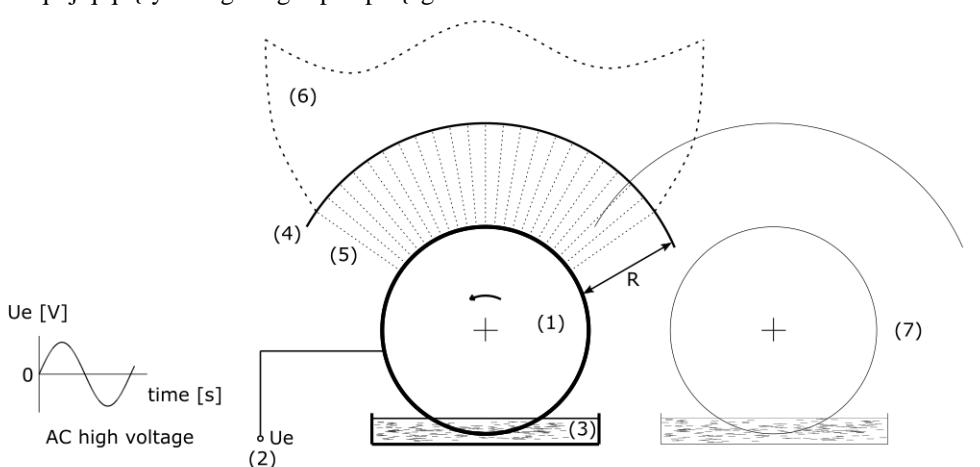
Results of carried out tests proved considerable effect of frequency, amplitude and waveform (sine vs square) on the distance R. In a multi-disc configuration, it was observed that spinning under lower frequencies improves the interconnection of nanofibers from individual discs and enables production of a single flat nanofibrous structure. Acquired results from single/multi-disc AC electrodes will be further used for improvement of homogeneity that is required for medical, hygiene or filtration application.