SYNTHESIS AND ANALYSIS OF YTTRIUM ALUMINIUM GARNET DOPED WITH TANTALUM, CALCIUM AND EUROPIUM OR CERIUM

Ruta Juodvalkyte1, Monika Skruodiene2, Ramunas Skaudzius1

1 Institute of Chemistry, Faculty of Chemistry and Geosciences Vilnius University, Naugarduko 24, LT-03225, Vilnius, Lithuania

2 Institute of Solid State Physics, University of Latvia 8 Kengaraga str., LV-1063 Riga, Latvia

[email protected]

The growing need for LEDs and laser development by human society demands environmentally friendly synthesis techniques, safe use and fabrication of low-cost novel multifunctional materials. One of the most suitable ways to solve this demand is the search for novel structure garnets for versatile applications with controllable broad color tuning and improvement of quantum yield, thermal and radiation stability.

Yttrium aluminum garnet (Y3Al5O12) is a very perspective host matrix for rare-earth (RE) ions. RE doped YAG has interesting optical properties that allows to use it in the optical fields. Moreover, YAG possesses high thermal and chemical stability, and good mechanical properties at high temperatures. These characteristics enable the use of YAG:RE for thermal barrier coatings and high-temperature structural applications [1], [2] [3], [4].

In recent experiments, it was noticed that Ta2O5 can help to improve phosphor's thermal, structural and optical properties. The main aim of this work is to investigate the concentration influence of Ta and Ca ions in doping to Y3-2xCa2xTaxAl4-xO12:1% Eu and Y3-2xCa2xTaxAl4-xO12:0,5% Ce synthesized by the citric acid sol-gel method.

The samples were prepared using different amounts of Ta and Ca (x=0.01 – 0.1). All samples were annealed at 1000 °C for 4 h in covered crucibles in the air to remove organic components and residual nitrates, then heat treated in 1300 °C for 2 h in the air or in a reduction atmosphere.

All synthesized samples were analyzed by the XRD method. The concentration influence of Ta and Ca ions on luminescence properties are discussed in detail. The optimal concentration of these ions is also determined.

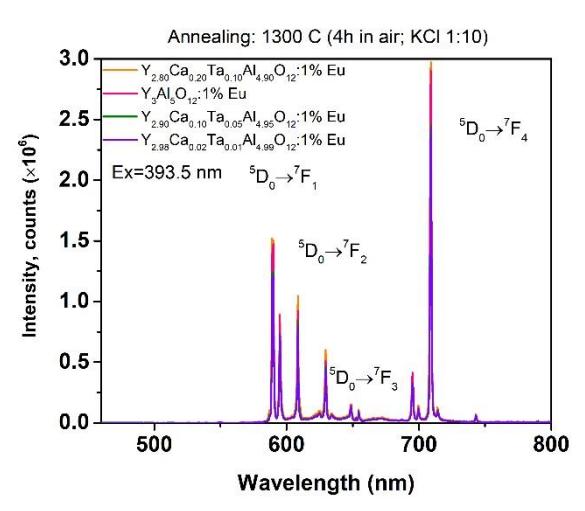
Excitation and emission spectra are presented in Fig. 1. and Fig. 2. respectively.
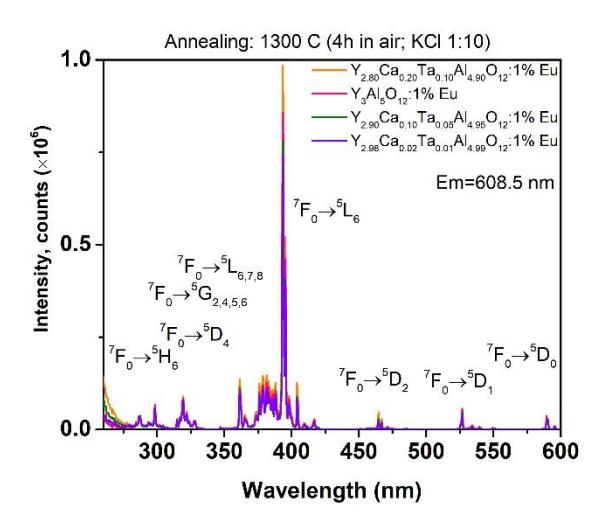
Figure 1
Fig. 1. Excitation spectra of Y3-2xCa2xTaxAl4-xO12:1% Eu.
Figure 2
Fig. 2. Emission spectra of Y3-2xCa2xTaxAl4-xO12:1% Eu.

[1] Mączka, M., Bednarkiewicz, A., Mendoza-Mendoza, E., Fuentes, A. F., & Kępiński, L. (2014). Low-temperature synthesis, phonon and luminescence properties of Eu doped Y3Al5O12 (YAG) nanopowders. Materials Chemistry and Physics, 143(3), 1039–1047. https://doi.org/10.1016/j.matchemphys.2013.11.002.

[2] Borlaf, M., Frankowska, M., Kubiak, W. W., & Graule, T. (2018). Strong photoluminescence emission at low dopant amount in YAG:Ce and YAG:Eu phosphors. Materials Research Bulletin, 100(August 2017), 413-419. https://doi.org/10.1016/j.materresbull.2018.01.005.

[3] Paula de Sousa, B., Marcondes, L. M., Maestri, S. A., Ramos da Cunha, C., Cassanjes, F. C., & Poirier, G. Y. (2020). Phosphate glasses with high tantalum oxide contents: Thermal, structural and optical properties. Materials Chemistry and Physics, 239(May 2019). https://doi.org/10.1016/j.matchemphys.2019.121996.

[4] Marcondes, L. M., Santagneli, S. H., Manzani, D., Cassanjes, F. C., Batista, G., Mendoza, V. G., Ramos da Cunha, C., Poirier, G. Y., & Nalin, M. (2020). High tantalum oxide content in Eu3+-doped phosphate glass and glass-ceramics for photonic applications. Journal of Alloys and Compounds, 842, 155853. https://doi.org/10.1016/j.jallcom.2020.155853.