
Budding yeast (Saccharomyces cerevisiae) is one of the most well-studied and understood eukaryotic organisms. Yeast cells could be used for whole-cell bioprocesses such as biocatalysis and recombinant protein fermentation, but natural barrier functions of the cell wall and cell membrane often retards entry of substrates and release of products [1]. One of the possible techniques which could be used to improve permeability for target molecules is pulsed electric field (PEF), yet there is still a lack of sufficient data related to the effects of PEF on yeast cells especially in combination with whole-cell bioprocesses.
In this study we modified electrodes with whole yeast cells to detect electroporation effects. For the analysis, PEF-treated cells were immobilized on carbon paste electrodes which were then immersed into solution with potassium ferricyanide or menadione acting as mediators and producing measurable currents through oxidizing at electrode surface. Menadione-mediated amperometry was used for measurement of redox activity inside the yeast cells [2], while ferricyanide currents from amperometric sensor for lactic acid reflected membrane permeability (Fig 1.) [3]. Viability of cells was evaluated by counting colony-forming units. Leakage of intracellular compounds was evaluated by measuring fluorescence of supernatant or staining it with Ellman's reagent. Cells were exposed to single square shaped electric field pulses with pulse duration $\tau = 300 \mu s$ and electric field strengths (E) up to 16 kV/cm.
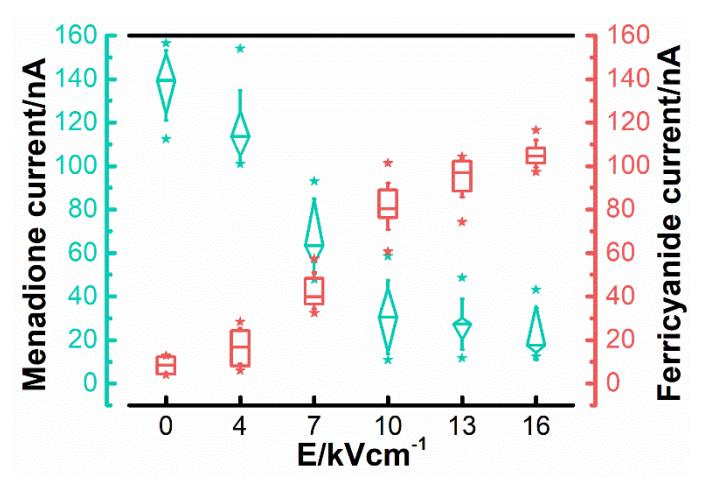
We showed that after exposure to PEF, permeability of cell membrane/wall increased while viability decreased. Yeast-modified electrode responses to lactic acid and menadione were dependent on PEF exposure. Currents obtained from amperometric biosensor with treated cells increased from $9 \pm 4$ nA (E = 0 kV/cm) up to $103 \pm 10$ nA (E = 16 kV/cm). PEF treated yeast cells also showed lower redox activity which decreased (from $138 \pm 15$ nA to $23 \pm 12$ nA) with raise in electric field strength (0 kV/cm up to 16 kV/cm). Decrease of menadione-mediated current showed similar pattern with viability. Viability of yeast cells decreased (from 100 % up to $\sim 2$ %) with raise in electric field strength (E = 10 kV/cm). We conclude that amperometric measurements can be effectively used for investigation of various cellular responses after PEF treatment.