Protein misfolding is a common cellular event that can occur throughout the lifetime of a cell. The accumulation of misfolded proteins in the brain is a hallmark of several neurodegenerative diseases. For example, $\beta$-amyloid is associated with Alzheimer's disease. In the Alzheimer's brain, abnormal levels of this naturally occurring protein clump together to form plaques that accumulate between neurons and disrupt cell functions [1]. S100A9 protein has amyloid-like properties and can be found in extracellular senile plaques together with $\beta$-amyloid. S100A9 is involved in aggregates formation and inflammatory processes associated with neurodegeneration [2]. In this work the interaction of S100A9 and $\beta$-amyloid with membrane model systems was studied. Tethered bilayer lipid membranes (tBLM) and liposomes were used as simplified membrane models for these studies. The aim of this work was to form tethered bilayer lipid membranes [3] and unilamellar liposomes with encapsulated fluorescent calcein and use them to study interaction with misfolded proteins.
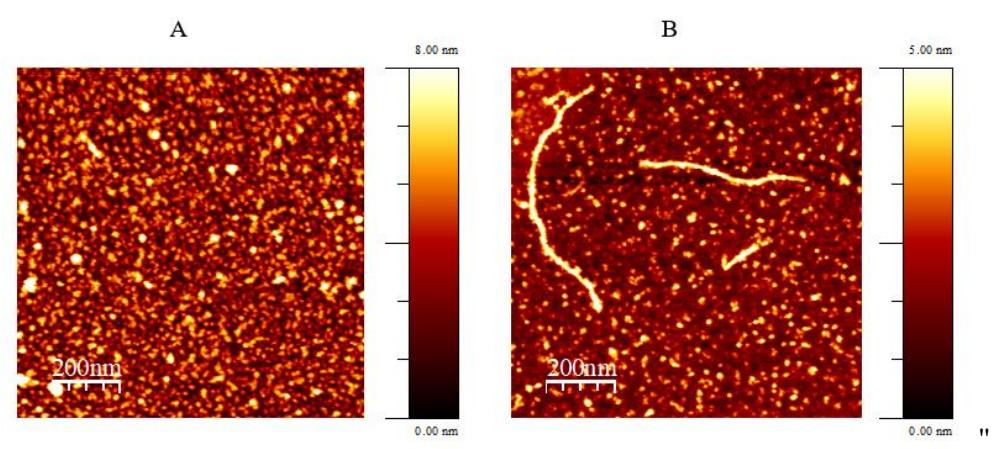
Atomic force microscopy (AFM) and dynamic light scattering (DLS) methods were used for characterisation of S100A9 and $\beta$-amyloid (Fig. 1). By employing electrochemical impedance spectroscopy and fluorescence spectroscopy, we investigate interaction of phospholipid bilayer with S100A9 and $\beta$-amyloid depending on their oligomerization state.