The whispering gallery modes (WGM) micro resonators are based on ellipsoidal objects, which can be made from optically transparent materials, that can enable optical wave circulating inside the ellipse using total internal reflection. If there is a monochromatic light source with constant intensity to the ellipse, constructive interference may be observed [1, 2]. Poly methyl methacrylate acrylic (PMMA) WGM micro resonators are commercially available with typical optical quality factor of 103-104 [3]. These could limit problems with WGM micro resonator expensive manufacturing. Because of advances in high resolution image processing, read-outs using spectroscopy (single photo detector) could be replaced with image processing. Image processing (4.5µm/px) allows to split elliptical WGM micro resonator in regions and analyze separate sectors of the ellipse [4], which can used as a representation of surface irregularity [5] interaction with higher order special mode groups.
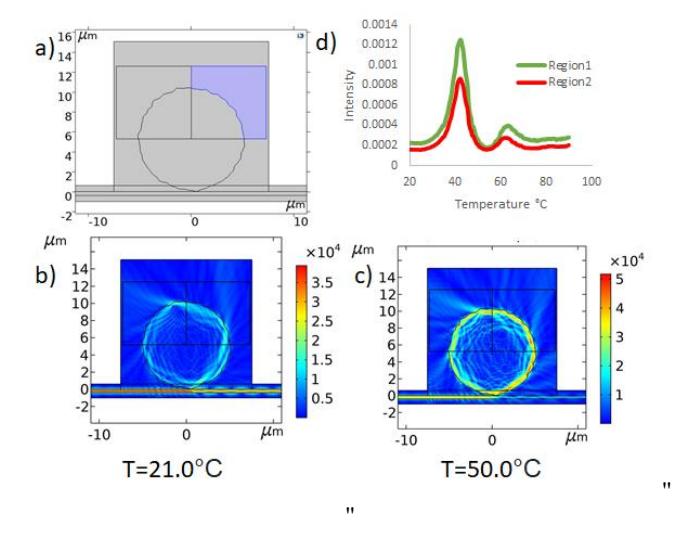
Fig. 1. COMSOL 2D geometry with 10µm diameter PMMA WGM micro resonator with randomly deformed surface coupled to 0.4 µm diameter tapered fiber waist region and the selected region at which the average light intensity is being measured. b) Electric field distribution on 10 µm diameter PMMA WGM micro resonator, which is coupled to 0.4 µm diameter tapered fiber waist regions with 760nm light propagating inside the fiber at 21°C. c) Electric field distribution on 10 µm PMMA WGM micro resonator, which is coupled to 0.4 µm tapered fiber waist regions with 760nm light propagating inside the fiber at 50°C. d) Average intensity distribution at different temperatures for two separate regions of WGM PMMA micro resonator.
In the present work new type of image processing for micro-resonators were developed, to analyze intensity distribution in separate regions for PMMA WGM micro-resonators in diameter range of 40-85 µm, that were coupled with tapered fiber waist region and fixed wavelength laser (760nm). Temperature was changed from 20-80 °C which effect the PMMA refractive index (${\alpha}$), for 760nm dn/dT = -1.32$\times$10-4 (°C-1) and thermal expansion (${\beta}$) which is 2.60$\times$10-4 (°C-1). Combining the following physical changes, total changes (${\alpha}$+ ${\beta}$), WGM PMMA micro-resonator mode mapping was obtained. The following work offers new type of intensity processing methods for measuring applications using PMMA WGM micro resonators and interaction from higher order optical modes and surface deformations on micro resonator surface.
Acknowledgments: This research was funded by the Latvian Council of Science project No. Izp-2018/1-0510 and ERDF 1.1.1.5/19/A/003 grants.
[1] Y. Zheng, Z. Wu, P. Ping Shum, Z. Xu, G. Keiser, G. Humbert, H. Zhang, S. Zeng, and X. Quyen Dinh, Sensing and Lasing Applications of Whispering Gallery Mode Microresonators, Opto-Electronic Adv.1, 18001501 (2018).
[2] M. R. Foreman, J. D. Swaim, and F. Vollmer, Whispering Gallery Mode Sensors: Erratum, Adv. Opt. Photonics7, 632 (2015).
[3] R. Berkis, J. Alnis, A. Atvars, I. Brice, K. Draguns, and K. Grundsteins, Quality Factor Measurements for PMMA WGM Microsphere Resonators Using Fixed Wavelength Laser and Temperature Changes, Proc. 2019 IEEE 9th Int. Conf. Nanomater. Appl. Prop. N. 2019 9 (2019).
[4] A. B. Petermann, T. Hildebrandt, U. Morgner, B. W. Roth, and M. Meinhardt-Wollweber, Polymer Based Whispering Gallery Mode Humidity Sensor, Sensors (Switzerland)18, 1 (2018).
[5] R. Popov, G. K. Shankara, C. von Bojnicic-Kninski, P. Barua, D. Mattes, F. Breitling, and A. Nesterov-Mueller, Stochastic Deposition of Amino Acids into Microcavities via Microparticles, Sci. Rep.9, 1 (2019).