Biological sensors falls within the interdisciplinary field, which is one of the most active research areas in analytical chemistry [1]. Various cells, bacteria, antibodies, antigens, enzymes and multicellular living organisms are used to develop specific and selective biosensors [1,2]. Last decade the combination of enzymatic biosensors and electrochemical methods due their selectivity became very popular and found the application for diagnostic and monitoring in different area of industry, medicine and pharmacology [3]. About 85 % of the total biosensors market are glucose biosensors [4]. Electrochemical enzyme biosensors based on glucose oxidase play a significant role from simple, easy-to-use blood glucose tests until continuous glucose monitoring [1,2]. Various metal nanoderivatives, such as nanoparticles and nanostructures, are used to increase the electrode surface area and improve the electrical conductivity [4,5,6]. Biosensors with immobilized enzymes and metal nanoderivatives are characterized by high selectivity, sensitivity, rapidity, reversibility, reproducibility, practical application and well catalytic activities [4,5].
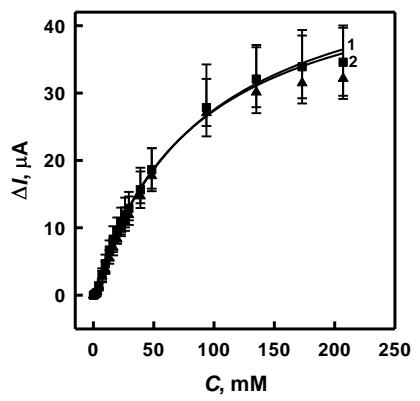
The aim of the research was to select optimal conditions for the development of glucose biosensor based on insoluble mediator 1,10-phenanthroline-5,6-dione and various types of gold and platinum nanoderivatives. For this purpose, graphite electrode was used as working electrode, chronoamperometry and cyclic voltammetry as electrochemical methods for the registration of analytical signal and the evaluation of the electrochemical process reversibility. It was investigated that electrochemically synthesized gold and platinum nanostructures in a combination with glucose oxidase offered some advantages (the facilitation of indirect electron transfer, higher surface area and the positive effect on the analytical signals) for the design of glucose biosensors. It was investigated that such compound as chitosan mixed with glucose oxidase and immobilized on the covered by gold or platinum nanoderivatives surface of graphite electrode does not have significant effect to the sensitivity of glucose biosensor. It was detected that more suitable is biosensor immobilized by one layer of each compounds in the presence of platinum due the high analytical signals and good repeatability. The optimal immobilization solution for platinum nanostructures formation and their covered conditions were investigated, then the basic analytical characteristics were evaluated. Furthermore, the developed biosensor also offers the possibility of using ultramicroelectrode designing for in vivo measurements.