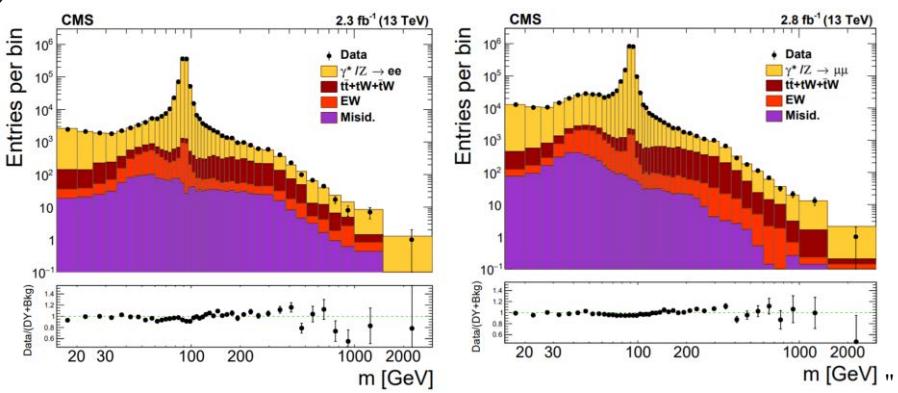
The Large Hadron Collider (LHC) at CERN accelerates protons to almost the speed of light and collides them together with 13 TeV collision energy. Short-lived heavy particles may be produced during such collisions, and investigation of these events allows physicists to further push the frontier of our understanding about the Universe. Colliding protons can be described as two opposite flows of quarks and gluons, according to the parton model. Any two (or more) partons may interact during the collision, producing new particles. There are different probabilities of different outcomes, which initially depend on the parton distribution functions (PDFs). PDFs describe probabilities of existence and energy fraction of specific partons inside a proton. PDFs must be measured with high precision in order to make correct predictions about proton interactions.
The Drell-Yan process takes place during a proton-proton collision, when a quark and an antiquark annihilate to create a Z boson or a virtual photon which nearly instantly decays into a charged lepton-antilepton pair (dilepton for short) [1]. Dilepton center-of-mass properties depend directly on four-momenta of the annihilating quarks. Therefore, precise measurements of Drell-Yan process differential cross sections are used to constrain the PDFs [2]. These measurements are also useful for testing the validity of higher-order corrections of the standard model as well as for a number of other experimental measurements where the Drell-Yan process is considered a background [3-5].
Charged leptons created during the Drell-Yan process usually have a high momentum and leave tracks that are well separated from tracks of other particles. This type of leptons is usually called “prompt.” There also are other processes that may produce prompt lepton pairs just like the Drell-Yan process. We refer to these processes as prompt lepton backgrounds. There is also a possibility that a poorly isolated lepton emerging from a hadronic jet or even the jet itself will be misreconstructed as a prompt lepton. This type of leptons is called “fake.” Typical fake lepton backgrounds are the W+Jets (one lepton is prompt and one is fake) and the QCD multijet (both leptons are fake) processes.
Fake lepton events have very large cross sections and very low probabilities to be selected as Drell-Yan event candidates. Therefore, the simulated fake lepton background predictions are usually inaccurate. Data-driven techniques are exploited to estimate such background yields. The “fake rate” method relies on measuring the fake lepton selection efficiency. The measured efficiency is applied on events containing fake leptons that have failed the selection to estimate the number of events that have passed it. In theory, a more sophisticated method is the “matrix method,” which additionally measures the prompt lepton selection efficiency. Both methods will be presented and compared in the context of the Drell-Yan differential cross section measurement using 2016 CERN CMS data recorded at $\sqrt{s}$ = 13 TeV.