
Periodontal disease is one of the most common condition in dogs and dental extraction is usually required [1]. Platelet-rich fibrin (PRF) membranes are widely and successfully used in the oral surgery of humans. Platelet-rich-fibrin membrane contains a fibrin matrix with leukocytes, erythrocytes, platelets, B and T lymphocytes, monocytes, stem cells and growth factors which provides better and faster tissue regenerating [2]. Faster wound healing helps to reduce the amount of nonsteroidal anti-inflammatory drugs and makes general comfort for the dog.
Clinical condition and periodontal disease stage were evaluated in the group of 11 dogs that had no any other chronic disease. The dogs were split in two groups (n1=6; n2=5): the procedure of tooth extraction and use of platelet-rich fibrin (n1=6); and procedure of standard tooth extraction (n2=5).
Procedure of closed dental extraction was made under general anaesthesia. Oral cavity was cleaned with chlorhexidine 0.12% solution. Whole blood sample (5 ml) was collected from saphenous vein into the sterile tube without anticoagulant. WB sample was centrifuged on 2400 rpm, 12 min., 500 g. After separation and compression, PRF membrane was put and fixated in the alveolar wound of the first group dogs (n1). Mucosal flap was created and sutured to close the wound. After the procedure the results of Early Wound Healing Score (EWHS) [3] and Pain Score [4] were evaluated on the first, third and seventh day after the procedure.
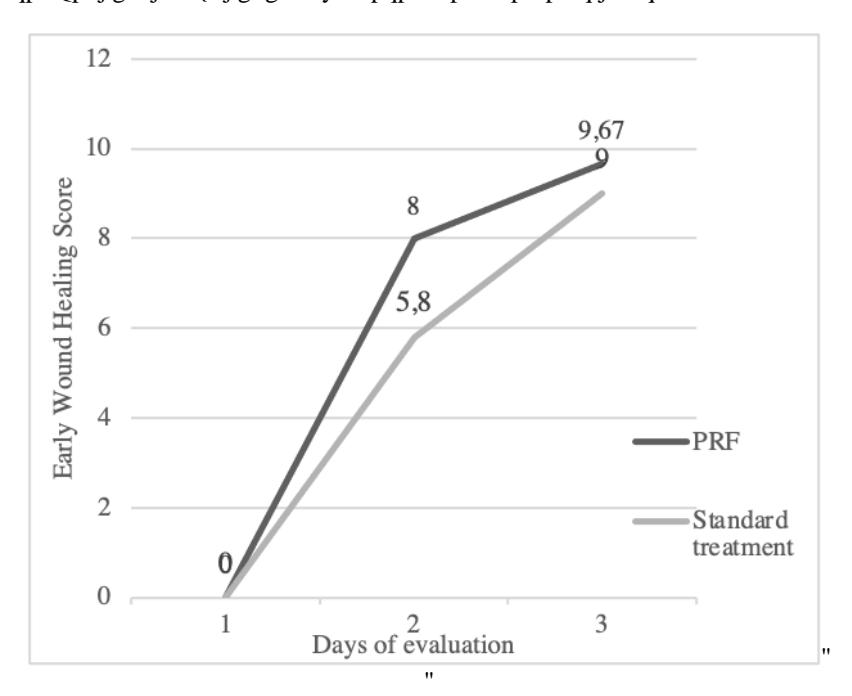
The average of EWHS after 3 days was significantly bigger in the group n1=8, $p<0.05$ where platelet-rich fibrin was used, comparing to the group n2=5.8, $p<0.05$ (Fig. 1). The same result, but with a less contrast between groups, was found after 7 days (n1=9.67, n2=9, $p<0.05$). The average of Pain Score in the first group with platelet rich fibrin was smaller comparing to the second group in the 1st (n1=0.83, n2=1.4, $p<0.05$) and 3rd (n1=0.17, n2=0.6, $p<0.05$) days of evaluation. On the 7th day the result was non-significant in both groups.
PRF may be a useful tool in post-extraction alveolar wound treatment but there is a need of more research about its concept in dogs.