
The most prevalent commercial nanomaterial products are widely released into the environment. Some nanomaterials are toxic to various aquatic organisms, but their influence on the aquatic organism's gut microbiota remains unknown [1]. One of the nanomaterials which effects on organisms and environment are quantum dots (QDs). Concentration of QDs in the compounds of aquatic environment is still unknown [2]. The ecotoxicological impact of QDs on aquatic organisms is an emerging problem, especially due to their nano-specific properties, physico-chemical transformation in the environment and release of toxic metals, such as Cd, from QDs structure [2]. Studies have shown that metals exposure alters the composition and metabolic profile of the gut microbiota at the functional level, and in turn, the gut microbiota alters the uptake and metabolism of metals and could cause the dysbiosis [3, 4].
The aim of the study was to examine the effects of commercially available semiconductors Cd based QDs (CdSe/ZnS-COOH. 4 nM), Cd free QDs (CuInS/ZnS-COOH, 4 nM) and Cd2+ (50 and 80 mg/L) on isolated gut bacteria of Salmo trutta fry depending on temperature and to evaluate the changes of microbiota.
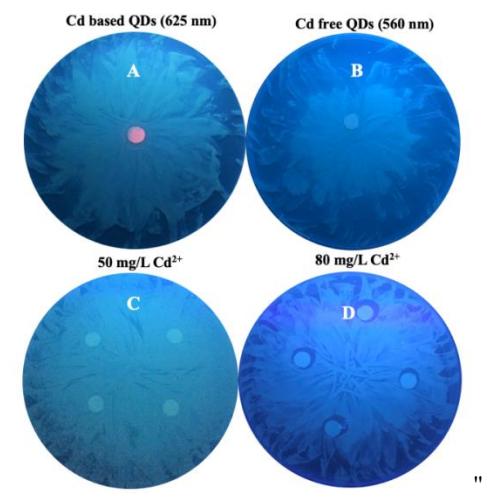
Isolates were identified by polymerase chain reaction and sequencing of 16S rRNA 1500 nt. Sequences of isolates AL13 and AL20 closely related to Aeromonas salmonicida subsp. salmonicida (similarity 99%), AL8 – to Aeromonas sp. (similarity 100%), AL2 – to Aeromonas popoffii (similarity 99%) and AL18 – to Shewanella putrefaciens (similarity 99%). Minimum inhibitory concentrations of Cd2+ against isolated Salmo trutta fry gut bacteria were determined by agar disc dilution method. Different concentrations were prepared and dispensed at 10 μl in each disc (6 mm diameter) of the bacterium-seeded tryptone soya agar plate and were incubated at 15°C and 25°C for 48 h aerobically.
The data obtained showed that the concentrations of tested QDs and 50 mg/L Cd2+ did not cause statistically significant inhibitory effect on isolated gut bacteria of Salmo trutta fry and this effect did not depend on temperature [Fig. 1 A; B; C]. Minimum inhibitory concentrations (MIC) value of Cd2+ was assessed by determining the lowest concentration of metal ion that caused growth inhibition of bacteria. The MIC value for isolated Aeromonas sp. (AL8), Aeromonas salmonicida subsp. salmonicida (AL13, AL20), Aeromonas popoffii (AL2) and Shewanella putrefaciens (AL18) was 80 mg/L Cd2+ concentration [Fig. 1 D].
This study of isolated gut microbiota of Salmo trutta fry after Cd-based and Cd-free QDs exposure in the future will allow predicting the potential health risk to aquatic organisms.
This work was funded by the Research Council of Lithuania, Project No. S-MIP-20-22.