Over the last two decades, magnetic nanoparticles have gained popularity due to their thermophysical properties, which can be applied in various disciplines - biology, medicine, chemistry, physics. There are many applications of nanoparticles and they are making progress in many fields of science: drug delivery, therapeutic agents for cancer treatment, magnetic resonance imaging, biological sensors, catalysts, magnetic recording media [1].
Magnetic nanoparticles are obtained from oxides of iron, cobalt, or nickel, which have special properties, such as surface and volume ratios, and high magnetic moments. Iron oxide nanoparticles are selected for magnetic studies due to their easy availability and superparamagnetic properties [2], [3]. The size of the nanoparticles ranges from 10 nm to 100 nm. The shape and size of nanoparticles are important parameters for synthesis and application because a large surface area increases reactivity, ion transfer, or contact. Besides, physical properties such as shape, composition, charge, and solubility can unpredictably change nanoparticles behaviour. It is therefore important to discover methods to obtain desired size, shape, and properties of magnetic nanoparticles [1].
Magnetic nanoparticles are synthesized using three different preparation routes a) biological methods, b) physical methods, and c) chemical methods. Physical methods are easy to perform, however, control of the particle size is difficult. Biological methods assuring low cost, high yield, reproducibility, but time-consuming. Chemical synthesis methods are mainly used due to low production cost and high productivity. Chemical synthesis route involves electrochemical method, sol-gel method, hydrothermal method, chemical co-precipitation, microemulsion, solvothermal method, microwave method. Comparing these techniques, each of them has advantages and disadvantages, depending on size, structure, time, yield, reproducibility. In all these techniques, aqueous medium is the most efficient pathway to obtain iron magnetic nanoparticles. It has been demonstrated that the particle size, as well as the polydispersity of the nanoparticles, could be tailored by changing factors such as Fe2+/Fe3+ ratio, base (NaOH, ammonium hydroxide), and ionic strength. Other factors as mixing rate, temperature, agitation, pH, and reactants ratio influence nanoparticles size as well [4].
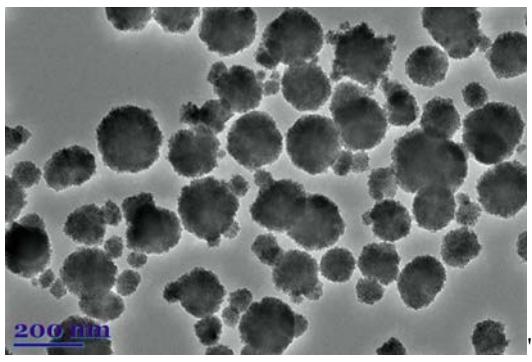
In this work, we present a comparison of iron oxide nanoparticles synthesized by microwave technique. Different synthesis time, temperature was investigated as well as reduction agent. Obtained nanoparticles were investigated using X-Ray Spectroscopy, Transmission Electron Microscopy and Raman Spectroscopy.