
Recently, to ensure the efficiency of various alternative energy sources to stop the greenhouse effect and utilize renewable organic materials, the focus is on biofuel cells [1]. Microbial fuel cell (MFC) bioelectrochemical devices available to directly transform chemical energy to electrical energy via a series of electrochemical reactions catalyzed by microorganisms. In the design of a microbial fuel cell, it is essential to choose not only the anode, redox mediators but also the microorganisms. Usually, few different yeast strains are used as biocatalysts in MFC with or without external mediators [2]. One of the most popular eukaryotic organisms is simple and easy to cultivate baker's yeast (Saccharomyces cerevisiae). They are resistant to environmental influences and can metabolize a wide range of substrates [3].
In this research, we used three electrodes system: quinones-mediated graphite rod as the working electrode, Ag/AgCl/KCl (3M) as a reference electrode, and platinum as the counter electrode. Cyclic voltammetry (CV) was applied for the electrochemical measurements. The changes in current density can be seen.
To improve charge transfer from the yeast cells to the electrode, we used two lipophilic mediators: i) 9,10-phenantrenequinone (PQ) and ii) 2-methyl-1,4-naphthoquinone (menadione, MD). Baker's yeast solution was sequentially changed by adding it in the same measurement cell. The result is shown in Figure 1.
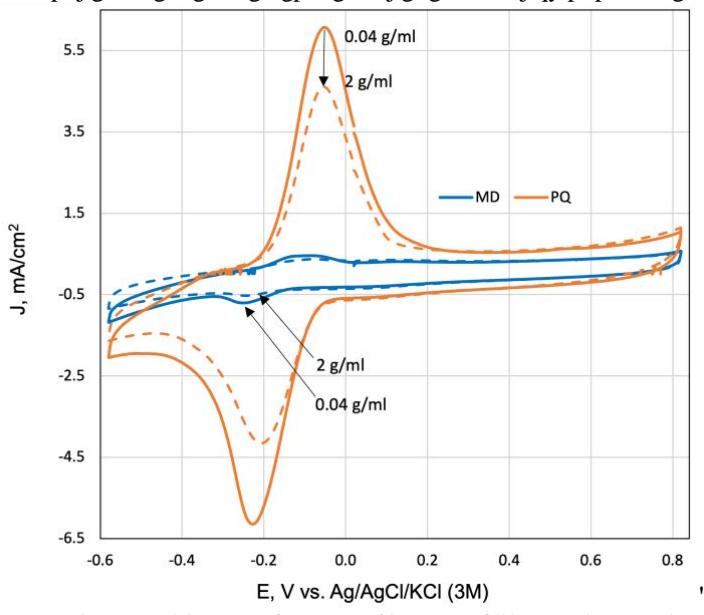
The current density decreased whit, increasing baker's yeast solution concentrations while using both MD and PQ mediators. While the yeast concentration was increased 50 times, the current density decreased by 1.3 mA/cm² with immobilized PQ and by 0.2 mA/cm² with MD. It means that it is unnecessary to use a high concentration of yeast in the biofuel cell to generate more electricity. To improve the efficiency of the MFC in the future, we need to consider modifying other components.