Viscosity and temperature play a major role on microscopic levels in biosystems. These parameters can determine diffusion rate and processes inside cells. Changes in a cell can happen during natural processes, as well as during the development of diseases or pathologies [1,2]. Fluorescent molecular rotors (FMRs) are the group of organic fluorophores, the luminescence of which is sensitive to medium's physical properties, such as viscosity or temperature. After FMR excitation intramolecular rotation occurs. Fluorescence intensity depends on the time molecule spends in the excited state before the rotation. Intramolecular rotation is fast in low viscosity solvents, which leads to an increased nonradiative relaxation. In contrast, in high viscosity solvents rotation is slow and a fluorescence intensity increases. Besides the fluorescence intensity, a quantum efficiency and a decay time also increases [3].
Boron-dipyrromethene (BODIPY) based FMRs are widely used as viscosity sensors. In between them, BODIPY-C10 and other its derivatives are the most popular molecular rotors. Their main advantages are mono-exponential decay and relatively high molar extinction coefficient [4]. However, their main drawback is absorption and fluorescence wavelengths. The most of the BODIPY based probes emit photons in a green spectral region, although while working with biological tissues red or near-infrared light is more desirable [5].
The main focus of this research was to shift an emission spectra to longer wavelengths by increasing conjugated system. Absorption and fluorescence emission spectra, as well as fluorescence decays have been recorded to characterize spectroscopic properties of the samples. Dependences on solvents polarity, viscosity, and temperature were measured.
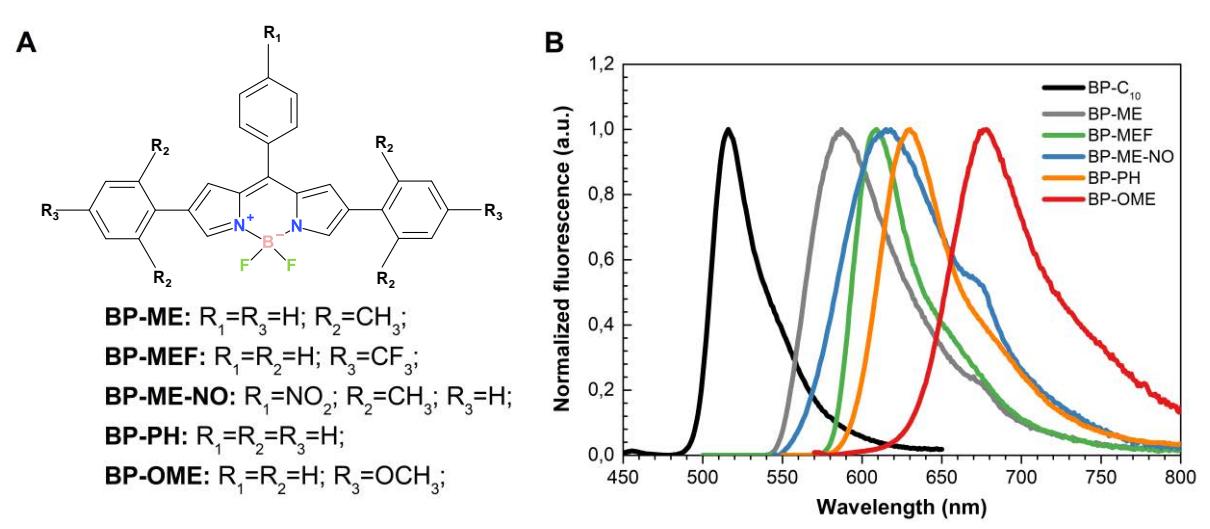
The obtained results show that extending the conjugated system results in a bathochromic shift of fluorescence spectra (Fig. 1, B). Measurements showed that BP-OME can be applied for sensing polarity instead of viscosity. BP-ME-NO showed approximately 4 times longer fluorescence decay time in viscous non-polar castor oil solvent in contrast to non-viscous non-polar toluene solvent. Therefore, it could be used as a viscosity sensor.