Most of the bacteria are naturally found living in sessile coordinated functional communities called biofilms. Microbial biofilms are widespread in the environment and form on biotic and abiotic surfaces if constant moisture is present. Adhesion of biofilms to different surfaces is promoted by the extracellular matrix that bacteria are self-embedded in [1]. Compared to floating or planktonic cells, one of the benefits of living in biofilms is the substantially higher resistance to adverse external physical and chemical impact [2].
Biofilms play an important role in human infections and can pose a potential threat to material integrity in confined facilities such as hospitals, food, and other industrial settings. Thus, nowadays, facing the enormously fast development of bacterial resistance to different conventional antimicrobial agents there is a need in a discovery and analysis of new, natural bacterial control methods that would be safe and effective to use, especially against recalcitrant bacterial biofilms [3].
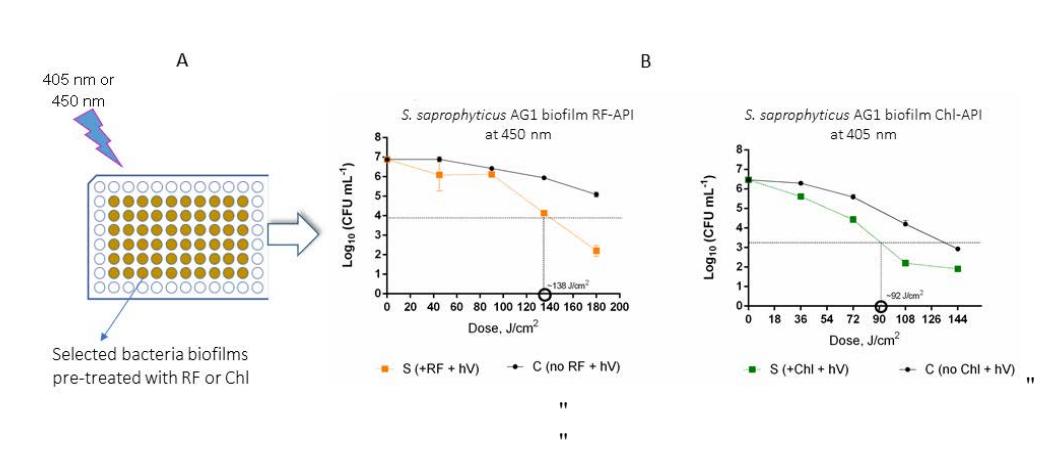
Therefore, this study aimed to investigate a photosensitization-based method known as antimicrobial photoinactivation (API) [4] against monocultural biofilms, as well as planktonic cells (to investigate prevention of biofilm formation) of Pseudomonas aeruginosa atcc 27853, Staphylococcus saprophyticus AG1 and Staphylococcus epidermidis atcc 12228 (only planktonic cells evaluated). For the API, natural photosensitizers (PS) such as riboflavin (RF) and chlorophyllin (Chl) in combination with appropriate photosensitizing visible-light irradiations were used. It was found that RF- and Chl-base API can have bacteriocidic effect against biofilms of the selected bacteria. However, considering actual application of the technology, concentration of selected natural PSs, irradiation doses and other optimization studies should be further performed.