
Expanding the coverage of laser sources spectral range is one of the most urgent scientific problems. Near infrared (NIR) lasers (0.7 – 1.1 μm) are well developed to provide high pulse energy, short pulse duration and high repetition rate. However, the wavelength conversion of ultrashort pulses in short-wave infrared (SWIR) spectral region (> 1.1 μm) with good efficiency has not yet been exhaustively studied. Picosecond and femtosecond pulse width SWIR laser sources are required for a wide range of applications, ranging from spectroscopy, biomedicine to material processing and metrology. In strong field physics, high peak power SWIR laser pulses allow to generate high harmonics and reach attosecond pulse width. In this case, increasing the fundamental wavelength makes it possible to achieve higher photon energy [1]. Also, recent studies have shown that with the increase in the wavelength of the laser source for excitation of THz radiation, the conversion efficiency grows by an one order of magnitude [2].
Stimulated Raman scattering (SRS) is a promising wavelength conversion method that also has advantages for pulse compression and its inherent phase matching in gas, liquid or crystalline media, eliminating the need for parametric crystals. However, stimulated Raman scattering with picosecond and femtosecond laser pulses suffers from lower energy conversion efficiency and nonlinear phenomena caused by the optical Kerr effect. The use of broadband supercontinuum pulses as a seed can improve efficiency and stability of SRS-conversion, maintaining beam quality.
The goal of this study was to investigate transient stimulated Raman chirped-pulse amplification (TSRCPA) and to determine the optimal conditions for broadband spectrum synthesis which allows to achieve a pulse width of 50 fs.
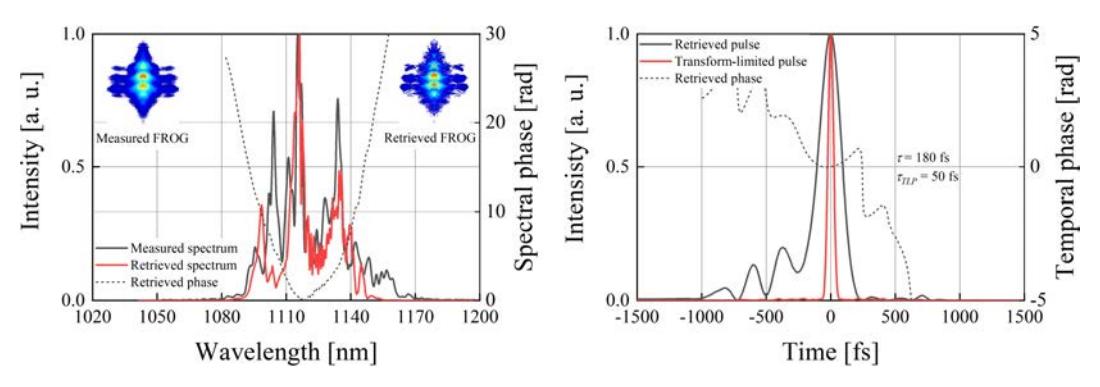
We report a two-stage TSRCPA system based on KGW crystals seeded with supercontinuum and pumped by 1.2 ps pulses at 1030 nm wavelength [3]. The anisotropic nature of KGW crystal allows several spontaneous Raman scattering modes, which depend on the pump polarization with respect to the crystal axis. This was achieved by rotating KGW crystal about $N_p$ optical axis and controlling pump and seed electric field vectors E parallel to the crystal axes $N_g$ or $N_m$ with Stokes shifts of 767 cm-1 and 901 cm-1, respectively. This made it possible to amplify the separate Raman scattering modes and synthesize a common broadband spectrum. In the first amplifier stage, the pump-to-signal conversion efficiency for the 901 cm-1 Stokes shift under optimal conditions reached 7 %. The second amplification stage operated in the 768 cm-1 Stokes mode and achieved a conversion efficiency of 35 %. Thus, this method of spectrum synthesis made it possible to achieve amplified pulse energy of 460 μJ and expand the spectral bandwidth to 35 nm at a central wavelength of 1120 nm, see 1 fig. left. Amplified pulse bandwidth was about 22 times the pump bandwidth. Eventually, the FROG measurement of the TSRCPA-amplified broadband pulses indicate linear phase modulation, which was partially compensated by N-SF11 prism pair compressor, providing pulse width of up to 180 fs (1 fig. right).