
Interest and studies into perovskite solar cells have been rapidly growing during the past few years. Hybrid perovskite can be a more efficient light absorber than commonly used silicon-based absorbers and might supplant them in the future. To achieve this goal, knowledge, and understanding in this field of study must be gained. In particular, our research focuses on the synthesis and investigation of the substances that would fit into the spacing layer of the 2D perovskites (2DPKs), as well as further characterization of the resulting hybrid material.
The crystal structure of the bulk perovskites is usually referred to as 3D. In the typical organic/inorganic perovskite, such as methylammonium lead triiodide, small organic cations with functional ammonium groups are filling the space between inorganic cations. To make it 2D, larger organic cations must be inserted into the 3D lattice. As the result, each inorganic perovskites sheet becomes separated from one another by the so-called spacing layer (Fig. 1). [1]
The majority of the 2DPKs crystal structures can be classified into two major classes: Ruddlesden-Popper and Dion-Jacobson. The exact crystal phase depends on organic cations that are used in the spacing layer. Monocations form the Ruddlesden-Popper phase, while dications form the Dion-Jacobson phase. Due to the absence of the interface between two separate organic molecules it is expected, that 2DPKs with Dion-Jacobson phase space will have better electrical properties, in comparison to that of with the Ruddlesden-Popper phase. [2]
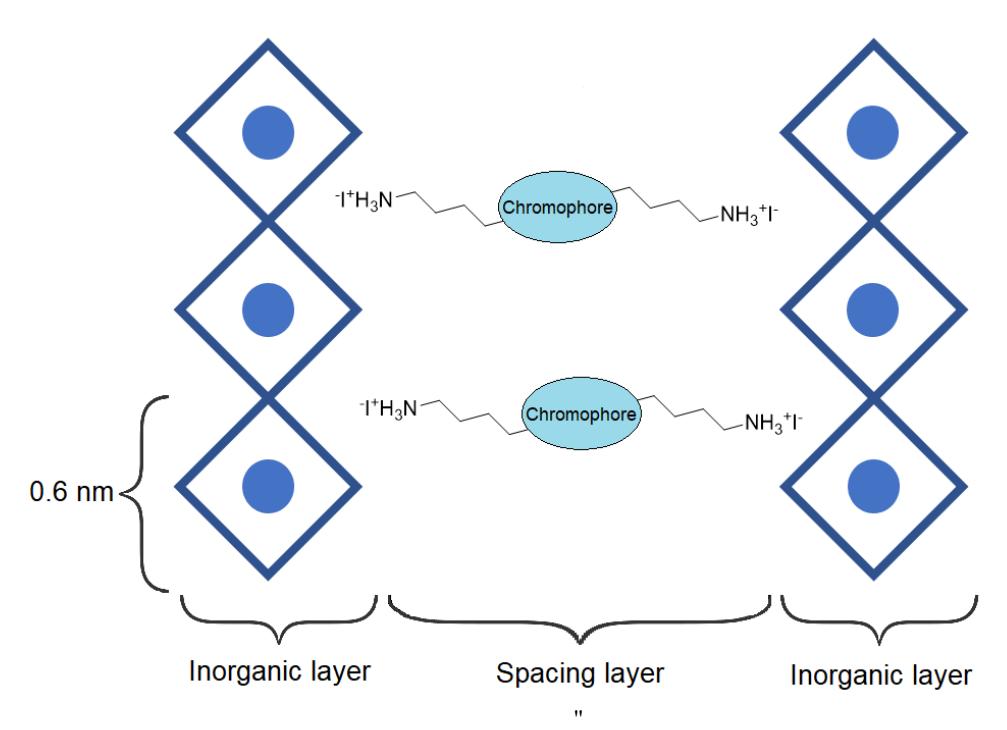
For this work, several commercially available organic chromophores have been selected for further modification, based on the width of the molecules and their optical properties. The cross-section of the chromophore should not exceed 0.6 nm, otherwise, it might be not possible to form a crystalline structure.
All synthesis in this work will be carried out in a few simple steps, i.e. chromophore reaction with N-(4-bromobutyl)phthalimide, followed by Gabriel synthesis, and finally treating the intermediate compound with hydrogen iodide.
During the further stages of this research, it is expected not only to synthesize and investigate new organic dications but also to find an easier and cheaper way to synthesis them, rather than to look for specific synthesis paths. This would allow us to broaden the explored space of materials and further advance this field.