
Preservation of yeast cell viability is essential in research and the food industry. In research it is important to maintain strains possessing useful traits for long periods of time. Meanwhile, in the food industry viability is required for efficient fermentation of food products like frozen dough [1]. Preservation is often achieved by freezing, which can cause formation of ice crystals and the removal of water from within the cells [2]. Cryoprotectants like trehalose, which naturally occurs in yeast, are used to inhibit these freezing injuries. Multiple studies show that tolerance to freezing is strongly related to the concentration of intracellular trehalose [3-5]. Cryoprotectants have benefits both extracellularly and intracellularly, but only few cryoprotectants could enter the cells straight from the media. One of the techniques that could improve yeast cells permeability to cryoprotectants by weakening membrane barriers is exposure to pulsed electric fields (PEF).
In this study we investigated electric field induced effects by analyzing yeast cell viability. In order to find optimal treatment conditions for the introduction of cryoprotectant, cell suspension was exposed to pulses with different electric field strengths (E $\le$ 8 kV/cm). Before exposure to electric fields yeast cells were washed twice with electroporation buffer and resuspended in electroporation buffer supplemented with D-(+)-Trehalose dihydrate or sorbitol. The yeast cell suspension was exposed to a single electric field pulse and thereafter soaked in the trehalose solution for up to 60 min before freezing. For evaluating freezing effects on yeast cells we kept cell suspension at -20 °C from 4 to 40 days (Fig. 1). Viability of cells was evaluated by counting colony-forming units. As a control, PEF untreated suspension was used. In order to validate whether PEF treatment improved the introduction of trehalose into yeast cells, we evaluated its concentration in yeast cells (μg of trehalose/mg of dry yeast mass). Extracts from yeast cell lysates were analyzed via chromatography.
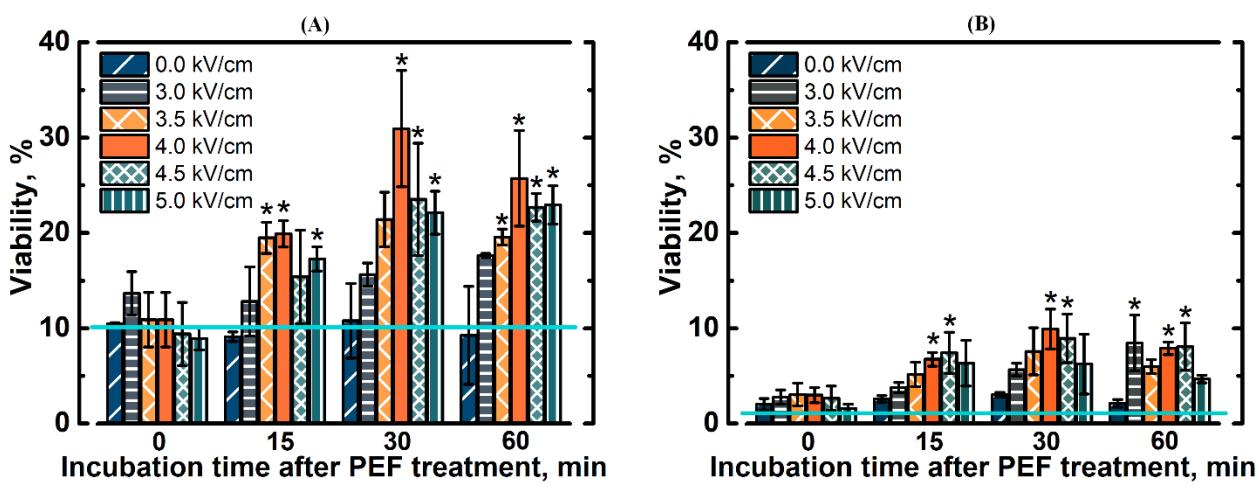
We showed that the PEF pretreatment could improve the freezing tolerance of yeast cells thus resulting in higher viability of up to 3 times. Pretreatment in trehalose solution also resulted in higher concentration of intracellular trehalose (by up to 60%) when compared to PEF untreated cells. The optimal electric field strength in the case of single square shaped pulse with duration of 150 μs was 4 kV/cm. Soaking time had an effect on the viability after thawing only for PEF-treated cells. The optimal soaking time after PEF treatment in trehalose solution was 30 min. Investigation of intracellular trehalose contents confirmed that its concentration increased with rise in strength of the electric field.
The prospect of our research is to develop a new freezing technology suitable for yeasts and other cells by increasing their resistance to freezing injuries without manipulating the genetic background.