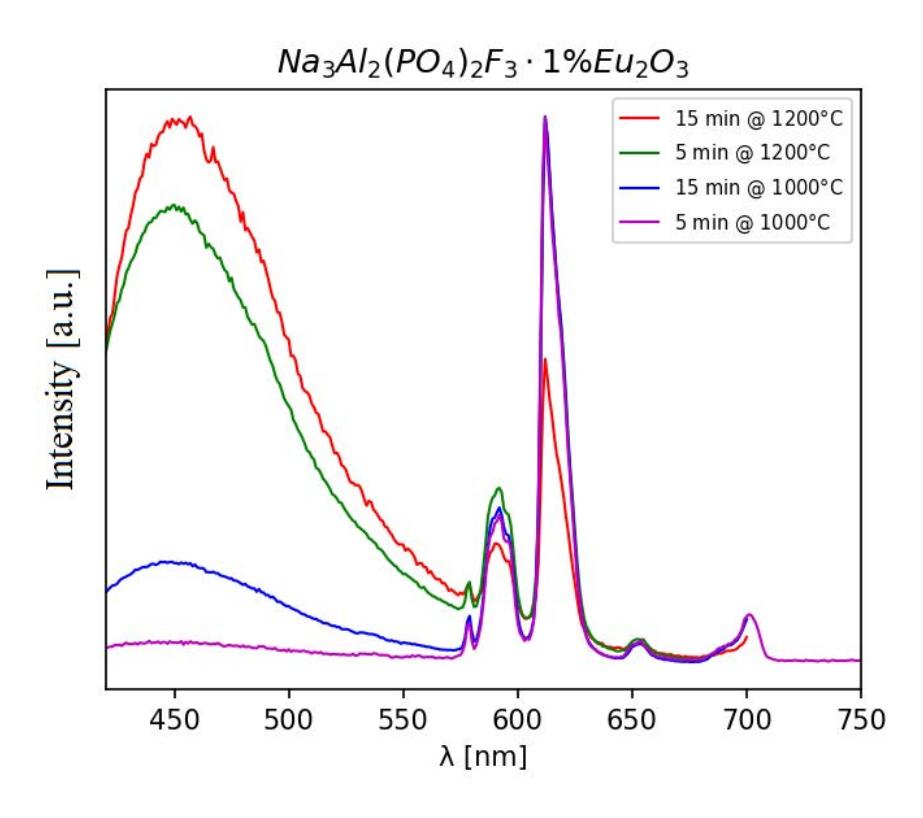
Over the past years, our group has been working on amorphous and nanocrystallised materials towards finding possible new cathode materials for Li-ion and Na-ion batteries [1], syntheses of glasses and their thermal nanocrystallisation, as well as methods to avoid oxidation of transition metals involved. Based on that experience, it was proposed to produce transparent glassy matrices doped with rare earth elements (REE), such as e.g. Eu, Pr. We studied the effects of the syntheses' conditions on REE ions reduction and adopted these correlations to control photoluminescence properties of samples.
Our recent work [2] proved that it is possible to synthesize REE-doped glassy materials whose photoluminescence spectrum can be tuned depending on synthesis conditions by using melt-quenching process. During that work we found out that one can control the relative Eu3+/Eu2+ ions concentrations. As both Eu3+/Eu2+ are photoluminescent in different parts of the visible range, the possibility of controlling their relative concentrations means that it is possible to "tune" photoluminescence spectrum of the material. Furthermore, emission can be “liken” to the natural light and strong UV/blue component which is present in spectra of many of today's white LEDs can be suppressed. This would make white LEDs more comfortable and healthier for the eyes than they are today [3]. It is also possible to adjust phosphors to other needed colors.
In this research, a glassy matrices based on borate and phosphate glasses were successfully synthesized by a melt-quenching process, using a double crucible method [4]. Samples obtained at different synthesis conditions were carefully investigated using X-ray diffractometry (XRD),), photoluminescence spectroscopy (PL), photoluminescence excitation (PLE) and absorption spectroscopy.