Growing demand on good quality storage systems is an extremely important global concern, e.g., for renewable energy sources – solar or wind power – when need for electricity is not that high and excess energy has to be stored. Hence comes the need for constant development of new solutions. Furthermore, similar but smaller systems are also a crucial part of every electric car. All of this has irrefutable influence on ecology and pollution reduction.
Nowadays, rapid technology development in the field of portable devices needs adjusting those devices' batteries in a way that their efficiency will improve. There is growing need for smaller, lighter and more efficient cell phones or personal computers and therefore also for batteries exhibiting improved properties. One of the factors that has significant influence on cells' parameters is the electrical conductivity of their cathode material. Therefore, scientists conduct researches on materials that potentially can be used as cathodes and search for ways to improve their conductivities.
An interesting method to improve this property is thermal nanocrystallisation of glasses developed in Solid State Ionic Division, Faculty of Physics, Warsaw University of Technology. Lithium manganese borate has found high interest in nowadays research on cathode materials for Li-ion batteries mostly due to its high theoretical gravimetric capacity of 222 mAh/g [1], which is even greater than for the widely studied phosphates. However, our research on this compound showed that final electrical conductivity after nanocrystallisation was still not sufficient enough. Basing on the studies [2] on vanadium-doped LiFePO4 compound and on conclusion that even small amount of vanadium can significantly improve electrical and electrochemical properties of material, we attempted to dope aforementioned LiMnBO3 with vanadium.
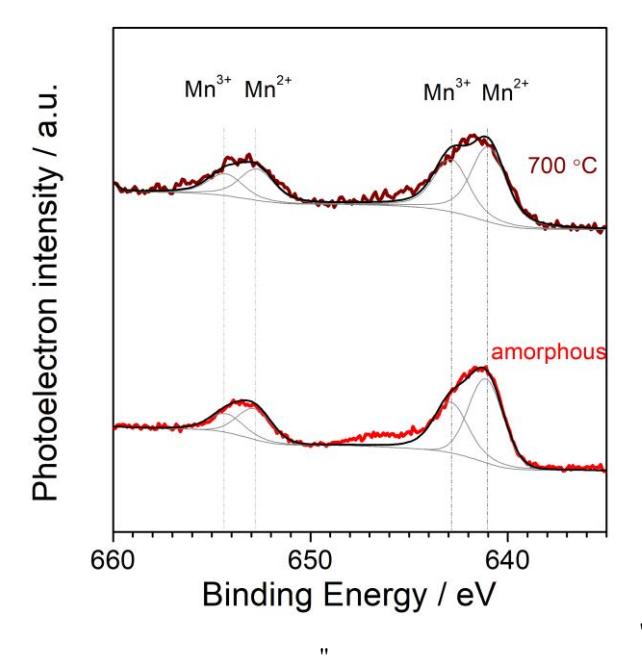
Glassy LiMn0.925V0.05BO3 was successfully synthesized with use of melt-quenching process. Then, the samples were nanocrystallised in different temperatures and characterized [3]. In this work, mainly XPS (X-ray photoelectron spectroscopy) studies (Fig. 1) will be presented in order to demonstrate changes in Mn2+/Mn3+ ions relative ratio before and after nanocrystallisation.