
Chirped mirrors (CMs) are special type of dielectric multilayer coatings intended for stretching or compressing of ultra-short (femtosecond) laser pulses. Various types of CMs were proposed in the past: double CMs (DCMs), back side coated CMS (BASIC), complementary CM pairs, and other [1]. Such effort allowed to compress optical pulses below 2 fs using complementary CM pair approach [1]. All of the mentioned CM configurations were implemented to reduce spectral oscillations of group delay dispersion (GDD) – the main parameter of CM. Large amplitude GDD oscillations may increase pulse duration, induce additional satellite pulses or distort optical pulse shape.
Most recent approach for reduction of GDD oscillations in CMs is by including a porous sculptured layer (PSL) as a top layer of CM structure [2,3]. Refractive index of PSL may be lower than refractive index of dense material and therefore better optical impedance matching between CM structure and ambient medium (i.e. air) may be achieved. However, optical parameters of such mirrors may be more sensitive to the humidity in the air due to water adsorption within the porous layer. Furthermore, the accuracy of porous layer deposition may be insufficient for CM application. So far, to the best of our knowledge, the CM with PSL with wider bandwidth than half an optical octave – an approximate bandwidth limit achievable by standard materials [1] – was never experimentally demonstrated before. In this work we designed and deposited a chirped mirror with over 400 nm (0.67 octave) spectral bandwidth. After deposition we investigated the sensitivity of spectral parameters to deposition errors and humidity changes.
Ion beam sputtering (IBS) technology and glancing angle deposition (GLAD) setup within electron beam evaporation coating plant were used to deposit chirped mirror coating (Fig.1a). 51 layers of Nb2O5/SiO2 materials were deposited using IBS technology. The last (52nd) layer of the coating was deposited with GLAD method (layer consisting of vertical columns was formed) [4]. After deposition, spectral parameters (transmittance coefficient and GDD) were measured at normal conditions (Fig. 1b) and in reduced humidity environment.
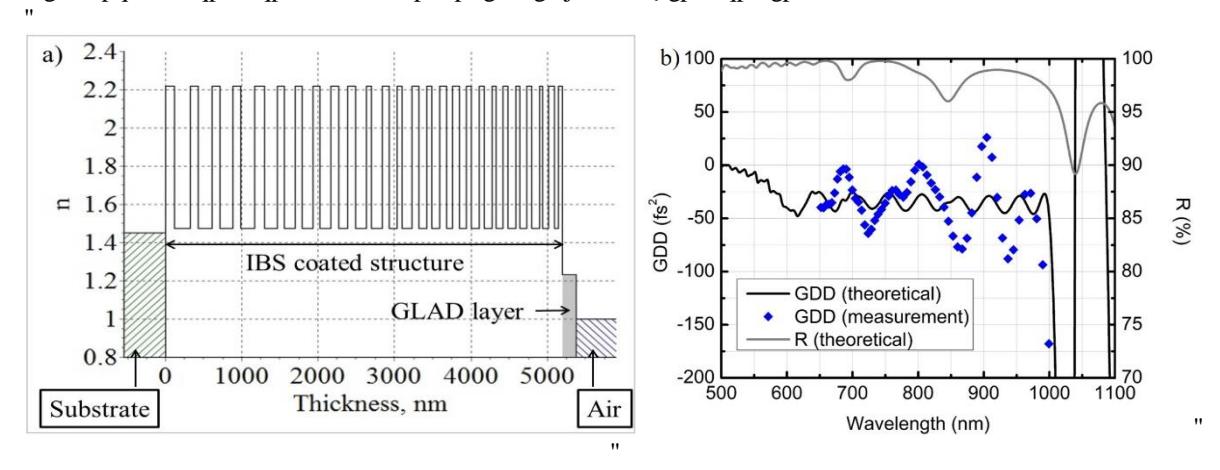
According to the measurements, GDD oscillations do not exceed -35°70 fs2 limits in wavelength range λ=650-1000 nm. Additional analysis showed that this amplitude is approximately 2-3 times smaller than theoretical limit for same bandwidth CM without PSL. Deposition error analysis indicated that the amplitude of GDD oscillations might have been reduced at least by half if IBS deposition errors had been avoided. However, variation of PSL refractive index due to humidity changes by approximately ±0.5 % was determined. It may lead to increase of GDD oscillations by ± 30 fs2 for theoretical design. Therefore, the GDD oscillations of at least ± 30 fs2 are expected even in well optimized and deposited CM with PSL.